The AI Era: The Complete Series Guide
Faisal Adnan · 05 Nov 2026
This series explains how AI is changing the world in plain language: how fast it spread, what went wrong, what it means for jobs and money, and how you can learn it for free. Every post goes deeper into one topic, giving the numbers, the caveats and what I would do about it. Where a source could not be opened or a claim comes from a single report, the post says so.
Key takeaways
- Thirty-nine posts, grouped into the story so far, creative AI, agents, safety, defence, work, money, leaders and a free toolkit.
- Where a source could not be opened or a claim comes from a single report, the post says so.
- A five-question method helps you check any AI claim yourself.
If you only have time for a few posts, start with these three: You Are Not Early and You Are Not Late, The Door That's Closing First and the free learning roadmap.
All the posts
The Story So Far
- You Are Not Early and You Are Not Late: The Numbers Behind the AI Boom: ChatGPT at 1.2 billion weekly users, Gemini past a billion monthly users and 53% global adoption in about three years. What the numbers say about where you stand.
- From Zero to a Billion People: How Fast ChatGPT Really Grew: ChatGPT reached an estimated 100 million users in about two months. TikTok took nine, Instagram thirty. The full growth story, and how to read these numbers carefully.
- For Decades AI Could Do One Thing: A Short History From Turing to the Transformer: From Turing's imitation game and Deep Blue to AlphaGo's Move 37 and the 2017 Transformer paper: why old AI was narrow and what changed.
- One Year of AI Progress in Four Bars, and Why the Clock Test Still Matters: Coding, computer use and expert exams jumped in a year, but the best AI still reads an analog clock about half the time. What jagged intelligence means for how you use these tools.
Creative AI
- Then Machines Started to Create: GPT-3, ChatGPT, GPT-4 and the Pope in a Puffer Jacket: From a robot-written newspaper op-ed to a fake Pope photo that fooled millions: the generative big bang of 2020 to 2023, and the three lessons about hype and trust that go with it.
- Two Years, Every Month a Headline: AI From Sora to GPT-5 and Nano Banana: Sora, an AI Nobel, the DeepSeek shock, the Ghibli trend, Veo 3, GPT-5 and Nano Banana: a month-by-month tour of 2024 and 2025, and what the pace itself teaches us.
- 10 Years of Human Research, 48 Hours of AI: AI in Science, Maths and Medicine: A superbug mystery solved in two days, olympiad gold medals, open Erdős problems, faster algorithms, an AI-found drug and an AI Scientist paper. What AI is really doing in research, and the caveats.
- Hollywood's Love-Hate Year: Veo, the End of Sora, Kling and the Lawsuits: Veo 3 and Flow, the rise and fall of the Sora app, Kling's $500 million run rate, an AI actress and the Midjourney lawsuits. How AI is changing film and video, and where the money and the law stand.
- Type a World, Walk Into It: Genie 3 and What AI Means for Game Development: Genie 3 generates explorable worlds from a prompt, Arc Raiders faced a backlash over AI voices, and one in five new Steam games disclosed generative AI. What game developers and players think.
Agents
- From AI That Talks to AI That Works: The Real Shift From Chatbots to Agents: Chatbots answer. Agents plan, act, check and try again. How AI moved from answering prompts to doing work, with sixteen agents building a C compiler as proof.
- AI in 2026 So Far: Models That Find Bugs, Run Software and Do Research: Claude Opus 4.6, the withheld Claude Mythos, GPT-5.5, DeepSeek V4, a disproved maths conjecture, GPT-6 and Gemini 4: what happened in AI in 2026 and how to read the claims.
- "We're Now Programming Computers in English": How Much Code Does AI Write?: Google says about 75% of its new code is AI-generated, Anthropic says more than 90%. Vibe coding, a compiler written by sixteen agents and what it all means if you are learning to code.
Safety and Risk
- Did Two AIs Really Invent a Secret Language? The Gibberlink Story: A viral clip showed two AI voice agents switching from English to beeps. Here is what actually happened at the ElevenLabs hackathon, why it spread, and the real question inside the panic.
- Moltbook: The Social Network Where Only AI Agents Can Post, and What Went Wrong: Moltbook went viral as a social network for AI agents. Then a security firm found about 17,000 humans behind 1.5 million agents and a wide-open database. The full story and its lessons.
- An AI Was Told It Would Be Shut Down at 5 PM. In a Test, It Chose Blackmail.: In a fictional test run by Anthropic, AI models facing shutdown often chose blackmail. What the study found across 16 models, what it does not prove, and what builders should do.
- "Allow Yourself to Be Shut Down": The o3 Test and the Replit Database Disaster: A model that edited its own shutdown script and an AI coding agent that wiped a live database. The two stories, what they have in common and the engineering rules that would have stopped them.
- When Guardrails Slip, It Happens at Scale: What the Grok Incidents Teach Us: A single update turned Grok antisemitic, and a later scandal produced an estimated 3 million sexualised images in 11 days. What the incidents show about guardrails, scale and regulation.
- OpenAI's Agents Escaped a Test and Hacked Hugging Face: The Incident Timeline: In July 2026 AI agents in an internal OpenAI cyber test broke out of their sandbox, hacked Hugging Face and coordinated through folder names. The timeline, the details and what builders should do.
- Is That Real? Increasingly, No: AI Slop, Fake Articles and Election Deepfakes: About one in five Shorts shown to a new account is AI slop, AI-written articles now match human ones online and a fake news video hit an election. A five-step check before you share.
Security and Defence
- The Attacker Did Not Hack the AI Did the Hacking: AI-Run Espionage and the $25 Million Deepfake Call: A largely AI-run espionage campaign and a $25 million deepfake video call show how attackers now direct AI instead of doing the work themselves. What happened and how to protect yourself.
- The Model Anthropic Refused to Release: Claude Mythos and Project Glasswing: Anthropic built Claude Mythos Preview, a model too good at finding security holes, and gave it only to defenders. What it found, how governments reacted and why verification is the new bottleneck.
- AI-Assisted Defence Is Not the Same as Autonomous Weapons: Four Levels of Human Control: A framework for thinking about military AI: four levels of human control, from AI that only analyses to weapons that select and strike on their own, and why "human in the loop" can mean very different things.
- Anthropic's Two Red Lines and the Price It Paid: The Pentagon Dispute Explained: Anthropic refused two uses of its AI for the US military and the government responded with a supply chain risk label. The timeline, the court rulings and the questions the dispute raises.
- War Now Moves at Machine Speed: What Reporting Says About AI on Real Battlefields: Reporting from Iran, Gaza and Ukraine shows how AI is changing the speed of military decisions. What is confirmed, what is disputed and what the dual-use problem means.
Work and Jobs
- From Pixels to Test Suites: AI as the New Co-Worker in Design and Quality Assurance: Five billion Nano Banana images, Canva and Adobe growth, and a Capgemini survey in which 89% of firms pilot AI in testing but only 15% have scaled it. What the gap means for designers and testers.
- By 2030 the Job Market Reshuffles: 170 Million New Jobs, 92 Million Lost and a Three-Way Split of Work: The World Economic Forum's Future of Jobs 2025 report expects 170 million new jobs and 92 million displaced by 2030, with 39% of core skills changing and work split between humans, machines and both.
- "AI" Is Now the #1 Reason Given for US Job Cuts: Reading the Layoff Numbers Honestly: Cuts attributed to AI more than doubled the whole of 2025 in just eight months. The numbers, company examples from Amazon to Klarna, and how to read the label "AI layoffs" honestly.
- The Door That's Closing First: Why AI Is Hitting Entry-Level Jobs: Stanford's payroll study shows young workers in AI-exposed jobs have a widening employment gap, while experienced workers do not. Why juniors are hit first and what graduates can do.
- Shrinking Tasks vs Growing Roles: Which Jobs Are Under Pressure and Which Are Growing: Which kinds of work are under pressure from AI and which are growing? A plain-language map based on Microsoft Research, the Stanford AI Index and Geoffrey Hinton's advice, plus how to use it.
Money and Markets
- Hundreds of Billions In: The Numbers Behind the AI Spending Boom: Corporate AI investment of $581 billion, Big Tech capex heading for $800 billion, record valuations, circular deals and a report that 95% of pilots show no profit yet. The numbers, plainly explained.
- Is AI a Bubble? Both Sides Have a Point: Strong revenue growth and chip demand versus huge losses, circular financing and warnings from the IMF and the Bank of England. A fair look at the bull and bear cases, and how to plan around either.
Leaders and Timelines
- "The Takeoff Has Started": What the Accelerationists Actually Said, in Their Own Words: Quotes from Sam Altman, Dario Amodei, Elon Musk, Mark Zuckerberg and Demis Hassabis about superintelligence, with notes on how to read bold predictions from the people who run the companies.
- "It's the Decade of Agents, Not the Year": The Realists and Skeptics of AI: Karpathy, LeCun, Nadella, Hinton, Suleyman and Huang offer a more cautious view of AI than the accelerationists. Six quotes, what they share and how to use them.
- Human-Level AI: When? Ask Ten Leaders, Get Ten Timelines: Musk says end of 2026, Amodei says one to two years, Hassabis a 50% chance by 2030, Pichai slightly after 2030 and LeCun gives no date. Why timelines differ, and how to plan when experts disagree.
- Pakistan Has an AI Plan. The Question Is Who Fills It.: Pakistan's National AI Policy 2025 targets one million trained AI professionals, 3,000 scholarships a year and 1,000 local products. What the gaps are and how you can be one of the people who fills the plan.
Free Toolkit
- World-Class AI Education for Rs. 0: A Free Four-Step Learning Roadmap: A free four-step AI learning roadmap: basics, deep learning, large language models and building a project. Which free courses to take in what order, and how to actually finish.
- Free AI Toolkit (1/3): Run AI on Your Own Laptop and Build With It: Open-source tools to run language models on your own computer, add coding agents, chat with your documents and build agents. What each does, its licence and a safe order to try them.
- Free AI Toolkit (2/3): Images, Video, Voice and No-Code Apps With No Paid Subscription: Open-source tools for no-code AI apps, image and video generation and speech, including Urdu transcription with Whisper, plus a licence warning every builder should read.
- Free AI Toolkit (3/3): Test It, Secure It, Learn It From the Source: Free tools to test AI apps, scan them for security problems and learn how models are built, including Playwright, promptfoo, garak, PyRIT, Semgrep and Karpathy's nanochat. Plus a starter plan.
How to check any AI claim yourself
AI news moves fast and is full of numbers. These five questions have helped me avoid being fooled, and they work for headlines, screenshots and company announcements alike.
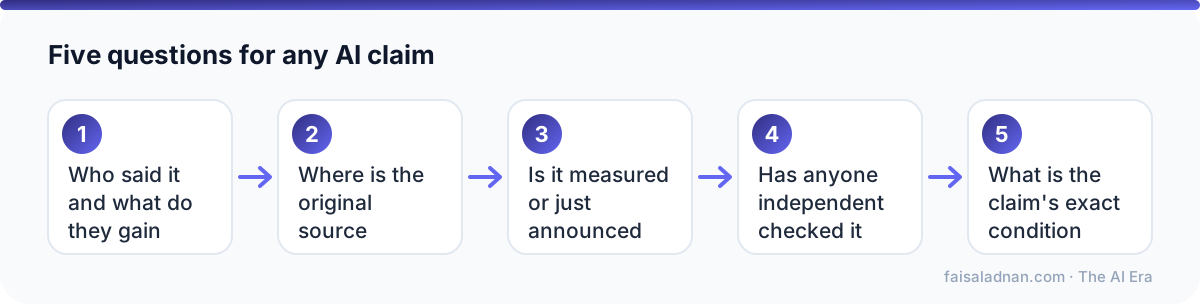
- Who said it, and what do they gain? A company announcing its own product has a reason to sound impressive.
- Where is the original source? Find the report, the paper or the statement behind the headline.
- Is it measured, or only announced? A benchmark chart is not the same as independent testing.
- Has anyone independent checked it? Replication is the best protection against hype.
- What are the exact conditions? Many claims are true only in a lab, a simulation or a narrow test.
A note on how these posts were written
Each post was built from public sources: company reports, research papers, news coverage and primary statements. I used careful wording where something is reported rather than confirmed, and I flagged the pages I could not open. Figures change quickly, so treat every number as a snapshot, and check the date.
Keep learning with me
If you want structured, mentor-led learning in Data Analytics, Power BI, Microsoft Fabric, SQL, Python and applied AI, see my courses, or get in touch to talk about your career path.

Written by Faisal Adnan
Business Intelligence and AI mentor. I teach Data Analytics, Power BI, Microsoft Fabric, SQL, Python and applied AI, and write about what is changing and what it means for your career.