AI in 2026 So Far: Models That Find Bugs, Run Software and Do Research
Faisal Adnan · 05 Nov 2026
2026 has been a year where models stopped being judged mainly by how well they chat and started being judged by what they can do: find security holes, operate software, and contribute to research. This post walks through the main events month by month, with a note on how much weight each claim deserves.
Key takeaways
- Release cadence is now measured in weeks, not years, and open-weight models trail the closed ones closely.
- An OpenAI model disproved Erdős's unit-distance conjecture. Tim Gowers called it a milestone, though I could not read the original report.
- An announcement is not evidence. Wait for independent tests before changing a project because of a benchmark.
February: Claude Opus 4.6
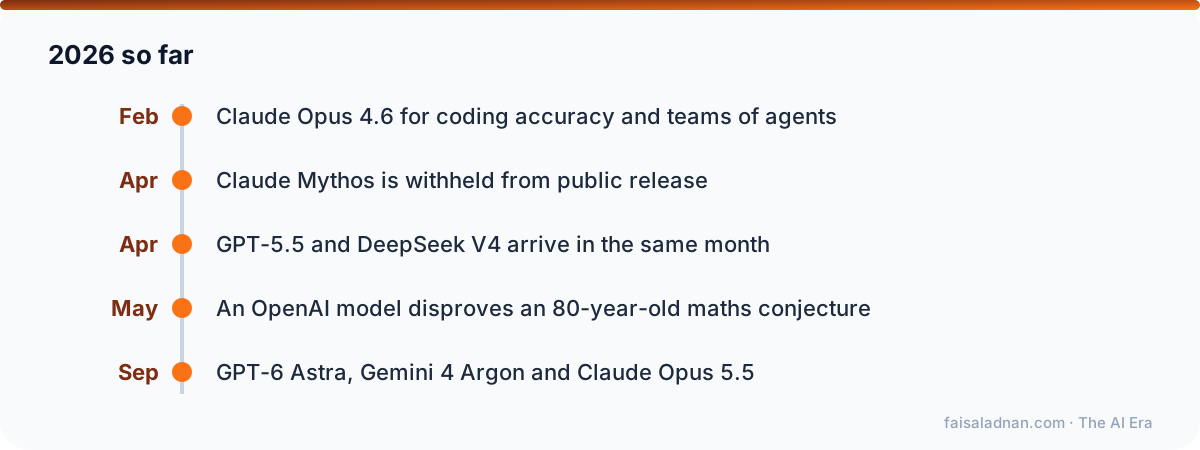
Anthropic launched Claude Opus 4.6 with upgrades in coding accuracy and performance. It is the model family tied to teams of coding agents and a very large working memory of a million tokens, roughly the length of several long books. Business Today covered the launch. The practical point: a larger memory means an agent can hold a whole codebase or a long report in mind at once.
April: Claude Mythos, withheld
Anthropic said it had trained a frontier model that was too capable at finding security weaknesses to release publicly. It described the project on its Project Glasswing page: a general-purpose, unreleased model, with the aim of helping secure critical software while defenders still have the advantage. I cover this story in detail in The Model Anthropic Refused to Release.
April: GPT-5.5 and DeepSeek V4
Fortune reported that OpenAI released GPT-5.5 to paid subscribers only six weeks after GPT-5.4, with the pitch of more agentic work and fewer hallucinations. In the same month DeepSeek released V4, an open-weight rival with a one-million-token context window.
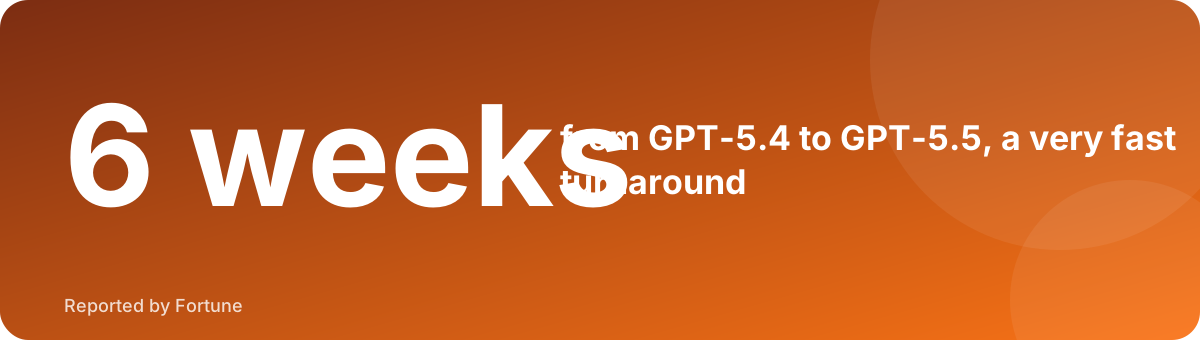
Two points are worth noticing. The release cadence is now weeks, not years. And open-weight models, whose parameters anyone can download, keep close behind the closed ones, which makes it harder for any single company to control where the technology goes.
May: an AI-assisted result on an 80-year-old maths conjecture
An OpenAI model disproved Erdős's unit-distance conjecture, a problem from the 1940s. The mathematician Tim Gowers called the result a milestone. This one matters because proving or disproving something new is different from answering exam questions someone has already solved. I could not load the original report while writing this, so I am treating the details as secondhand until I can read it myself.
September: GPT-6 "Astra"
The New Stack reported on the GPT-6 launch and its benchmarks. I noted the claim that it operates tools like Excel, Blender and Power BI the way a person does, and that OpenAI said we are now in the AGI era. That last line is a company claim, and I put it in quotes on purpose. Whether a system counts as AGI depends on a definition that nobody agrees on.
September: Gemini 4 and Claude Opus 5.5
TechCrunch reported that Google released Gemini 4 Argon on 30 September, calling it a workhorse for coding and cybersecurity work. Claude Opus 5.5 arrived around the same time as a near-frontier model at lower cost.
How to read all of this
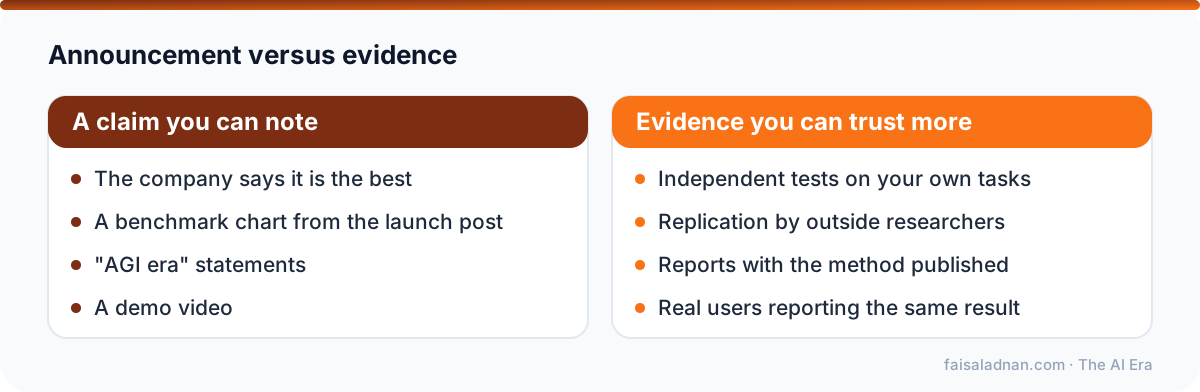
- An announcement is not evidence. Wait for independent tests before you change a project because of a benchmark.
- Cheaper near-frontier models usually matter more to learners than the single best model, because you can actually afford to use them every day.
- Security is now part of every release. Several of these models are marketed for finding and fixing vulnerabilities, which is good for defenders and worrying if the same skill reaches attackers.
What to do with this information
Pick one new tool from this list and test it on a task where you already know the right answer. Write down where it succeeds and where it fails. After a month you will have your own evidence, which is worth more than any launch-day chart. For a measured look at how much progress is really being made, read One Year of AI Progress in Four Bars.
Keep reading
- The Model Anthropic Refused to Release: Claude Mythos and Project Glasswing
- One Year of AI Progress in Four Bars, and Why the Clock Test Still Matters
- "The Takeoff Has Started": What the Accelerationists Actually Said, in Their Own Words
See the complete AI Era series
Written by Faisal Adnan
Business Intelligence and AI mentor. I teach Data Analytics, Power BI, Microsoft Fabric, SQL, Python and applied AI, and write about what is changing and what it means for your career.