Free AI Toolkit (3/3): Test It, Secure It, Learn It From the Source
Faisal Adnan · 05 Nov 2026
This final post in the toolkit series covers what many beginners skip: testing and security. It also lists the best free resources for learning how models are built from the inside. Tool names are plain text, with licences noted.
Key takeaways
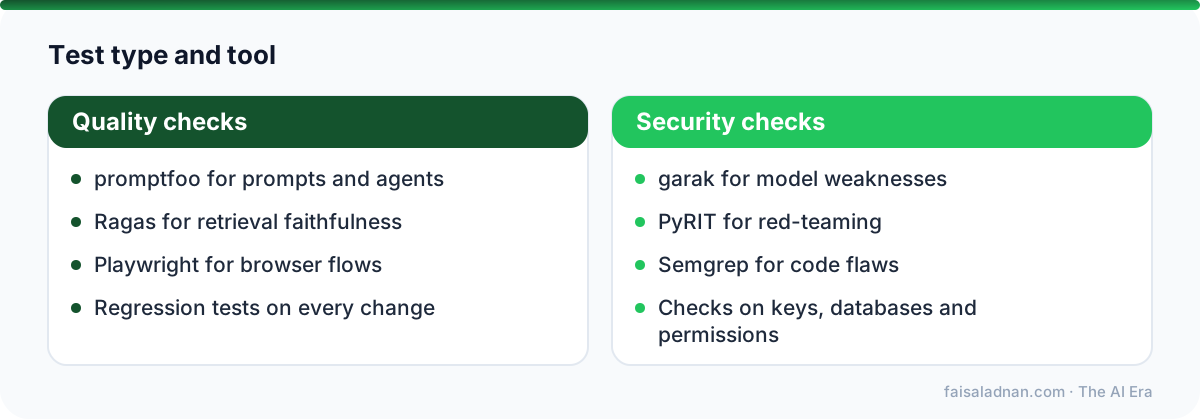
- promptfoo, Ragas and Playwright help you test prompts, retrieval answers and web apps.
- garak and PyRIT probe language models for weaknesses such as prompt injection and data leakage, and Semgrep scans code for flaws.
- Many incidents in this series were testing or security failures at root, and the market is short of people who can find these problems first.
QA and evaluation
- Playwright (Apache-2.0): automates browser tests across Chromium, Firefox and WebKit with one API.
- promptfoo (MIT): tests and red-teams your prompts, agents and RAG apps, and compares models side by side.
- Ragas (Apache-2.0): measures whether a retrieval-based system's answers are faithful to its sources.
AI security
- garak (Apache-2.0): NVIDIA's LLM vulnerability scanner. It probes for hallucination, data leakage, prompt injection, jailbreaks and other weaknesses. If you know nmap, think of it as nmap for language models.
- PyRIT (MIT): Microsoft's open-source toolkit for red-teaming generative AI, with automated scans and adaptive multi-turn attacks.
- Semgrep (LGPL-2.1): finds bugs and security flaws in code, in more than 30 languages.
ML core, data, games and design
- Transformers (Apache-2.0): thousands of pretrained text, vision and audio models.
- scikit-learn (BSD-3): classic machine learning made easy. It started in 2007 as a Google Summer of Code project.
- Chroma (Apache-2.0): a vector database that gives your app memory.
- Godot (MIT): a free 2D and 3D game engine with no royalties.
- Penpot (MPL-2.0): an open-source alternative to Figma.
Learn from the source
- nanochat (MIT): Karpathy's project to train your own ChatGPT-style model for around $100, on a single GPU node.
- Neural Networks: Zero to Hero (MIT): from the basics to building a GPT.
- Generative AI for Beginners (MIT): 21 lessons from Microsoft.
- Hugging Face Agents Course (Apache-2.0): a free, hands-on course on AI agents.
Why security and testing deserve your time
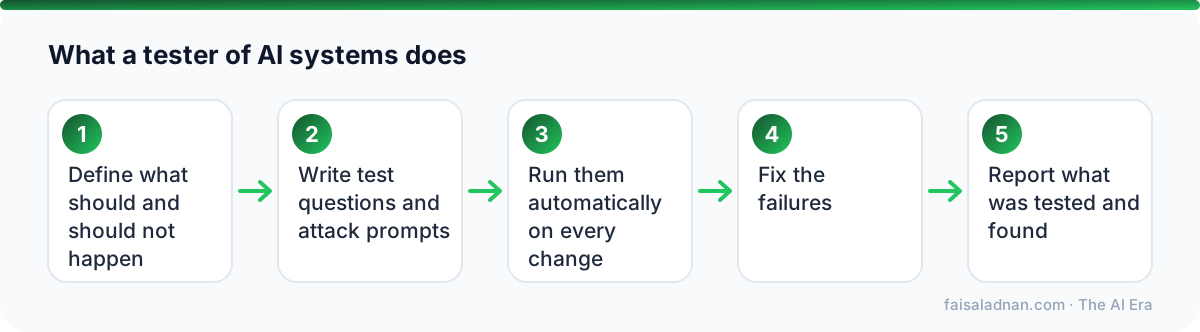
Every story in the safety posts of this series, from the exposed Moltbook database to the deleted production data, was a testing or security failure at its root. The market is short of people who can find these problems before users do.
A starter plan
- Write ten test questions for any chatbot you built. Run them with promptfoo each time you change a prompt.
- Scan a small app of your own with garak or Semgrep, and fix the first thing it finds.
- Write up what you tested and what you found. That write-up is a portfolio piece.
Only test systems you own or have written permission to test. Probing someone else's app without consent can be illegal, even if your intentions are good. For more on how this work fits into careers, read From Pixels to Test Suites. If you are starting out, return to the free learning roadmap for the order to learn things in.
Keep reading
- Free AI Toolkit (1/3): Run AI on Your Own Laptop and Build With It
- Moltbook: The Social Network Where Only AI Agents Can Post, and What Went Wrong
- From Pixels to Test Suites: AI as the New Co-Worker in Design and Quality Assurance
See the complete AI Era series

Written by Faisal Adnan
Business Intelligence and AI mentor. I teach Data Analytics, Power BI, Microsoft Fabric, SQL, Python and applied AI, and write about what is changing and what it means for your career.