Shrinking Tasks vs Growing Roles: Which Jobs Are Under Pressure and Which Are Growing
Faisal Adnan · 05 Nov 2026
It is tempting to ask "Will AI take my job?" The better question is "Which of the tasks in my job could AI take, and what is left?" Jobs are bundles of tasks. AI tends to remove some tasks while others grow in importance. This post sorts the evidence into two lists and then shows you how to use them.
Key takeaways
- Routine, codified, text-in/text-out work is under the most pressure, such as tier-1 support, translation, data entry and document review.
- Growing areas include AI and data engineering, cybersecurity, AI product roles, domain experts who use AI, and hands-on trades and care work.
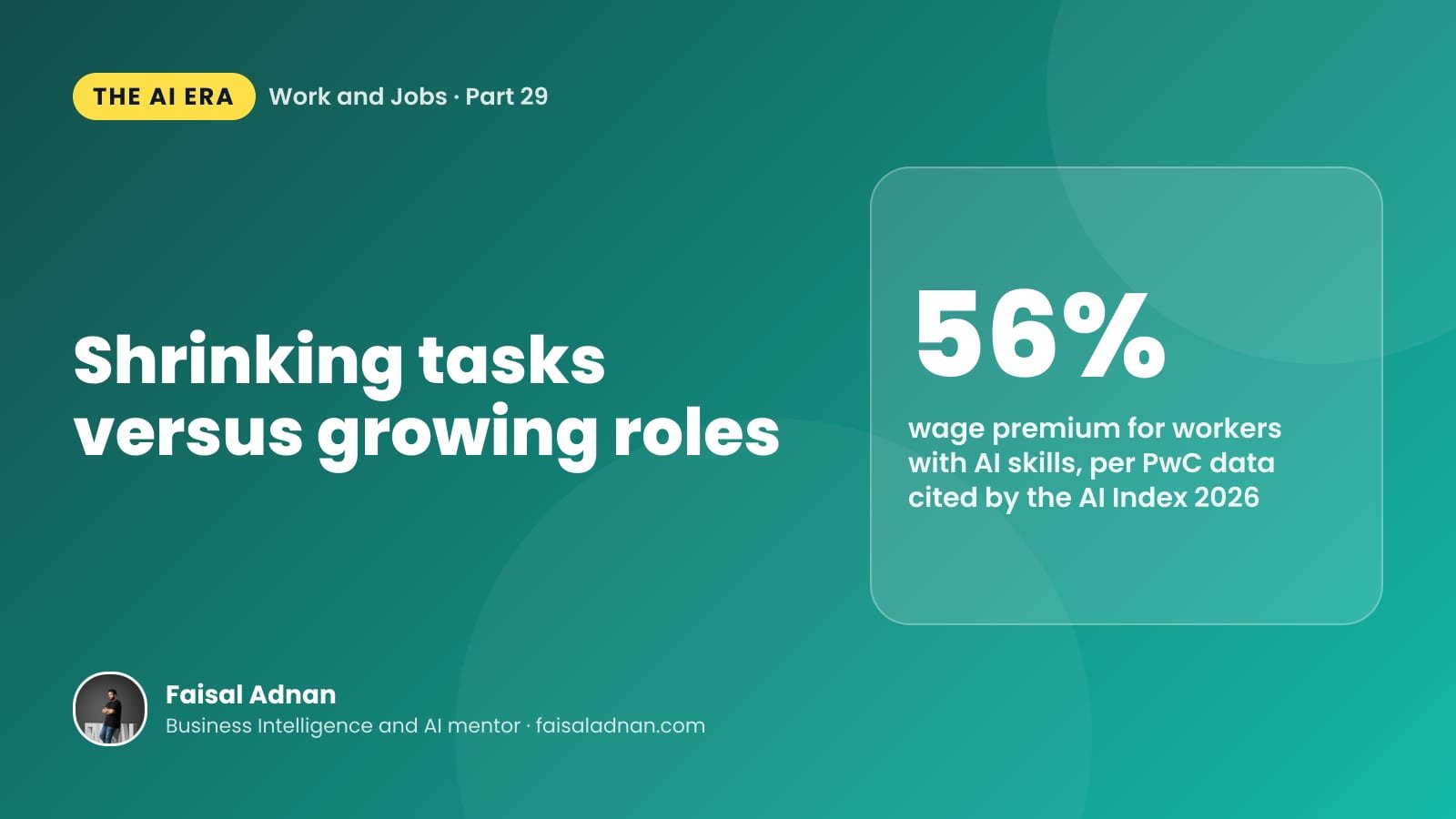
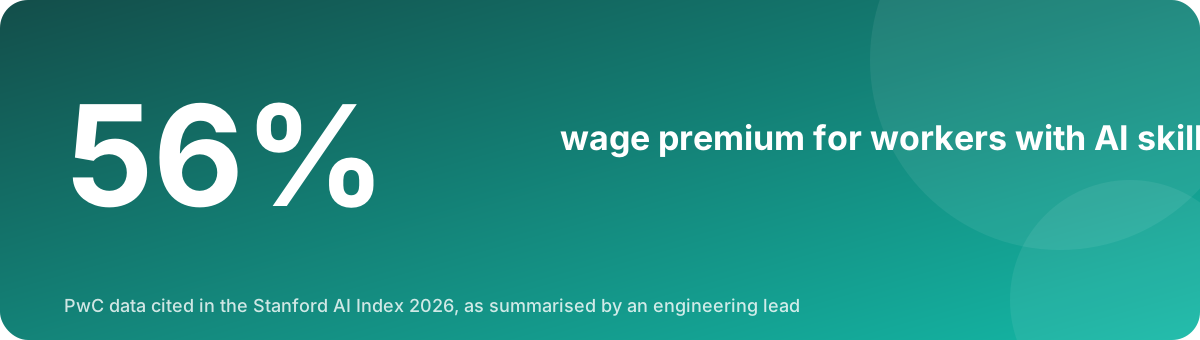
- Workers with AI skills command a 56% wage premium, according to PwC data cited in the Stanford AI Index 2026.
Under pressure
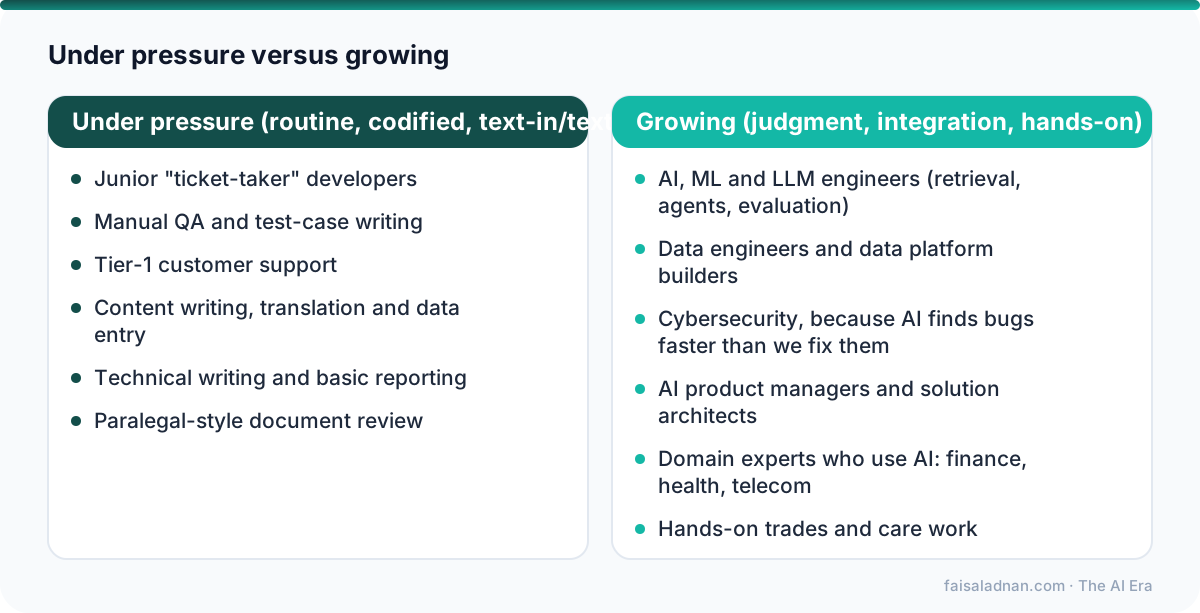
The left-hand list shares a pattern: the work is routine, codified and mostly text. Microsoft Research analysed 200,000 Copilot conversations to see which occupations overlap most with what AI does well. Fortune reported that translators, writers, customer service representatives and sales representatives were among the most exposed.
That is about task overlap, not a prediction that those jobs vanish. A translator who reviews and polishes machine drafts for legal accuracy is doing something different from a translator who types every sentence from scratch. The job changes. Whether it stays viable depends on whether the person moves up to the review and judgment layer.
Growing
The right-hand list has a different pattern: judgment, integration or physical presence.
- AI, ML and LLM engineers who build retrieval systems, agents and ways to test them.
- Data engineers and platform builders, because AI needs clean, well-governed data.
- Cybersecurity, because AI finds bugs faster than we fix them (see The Model Anthropic Refused to Release).
- AI product managers and solution architects who turn tools into working systems.
- Domain experts who use AI, in finance, health and telecom.
- Hands-on trades and care work, which depend on physical presence and human contact.
Two data points to remember
Geoffrey Hinton's advice in 2025, reported by Legal Cheek: AI is unlikely to hurt plumbers, but intellectual labour such as legal assistant work is at risk. He joked that people should train to be plumbers. The joke has a serious point: the tasks that are hardest to automate are often physical and local.
How to use the list
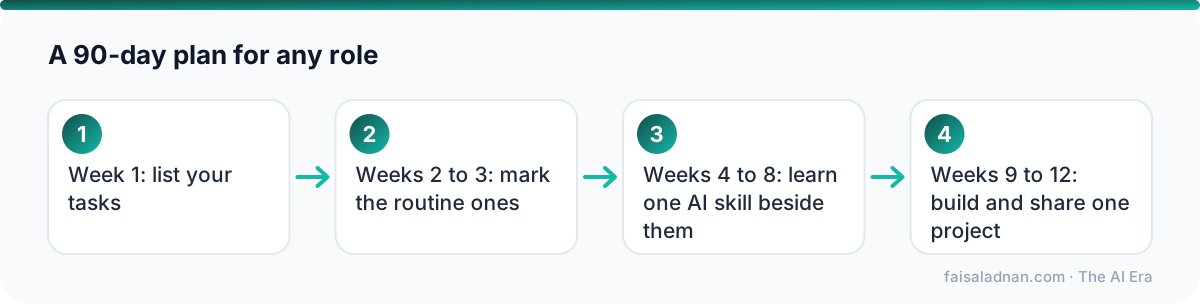
- Underline the tasks in your current or target job that are routine and text-based. Practise the next layer: reviewing, deciding and explaining.
- Pick one growing role and read five real job descriptions. Note the repeated skills. That list is your curriculum.
- Build one project that shows a growing skill. For a data person, it could be a pipeline, a dashboard with clear metrics, or an evaluation of an AI assistant.
Nobody can promise you a safe career. You can choose to move toward work that is harder to automate and easier to defend. If you do not know where to start, the free AI learning roadmap is a good first step.
Keep reading
- The Door That's Closing First: Why AI Is Hitting Entry-Level Jobs
- By 2030 the Job Market Reshuffles: 170 Million New Jobs, 92 Million Lost and a Three-Way Split of Work
- World-Class AI Education for Rs. 0: A Free Four-Step Learning Roadmap
See the complete AI Era series

Written by Faisal Adnan
Business Intelligence and AI mentor. I teach Data Analytics, Power BI, Microsoft Fabric, SQL, Python and applied AI, and write about what is changing and what it means for your career.