Hundreds of Billions In: The Numbers Behind the AI Spending Boom
Faisal Adnan · 05 Nov 2026
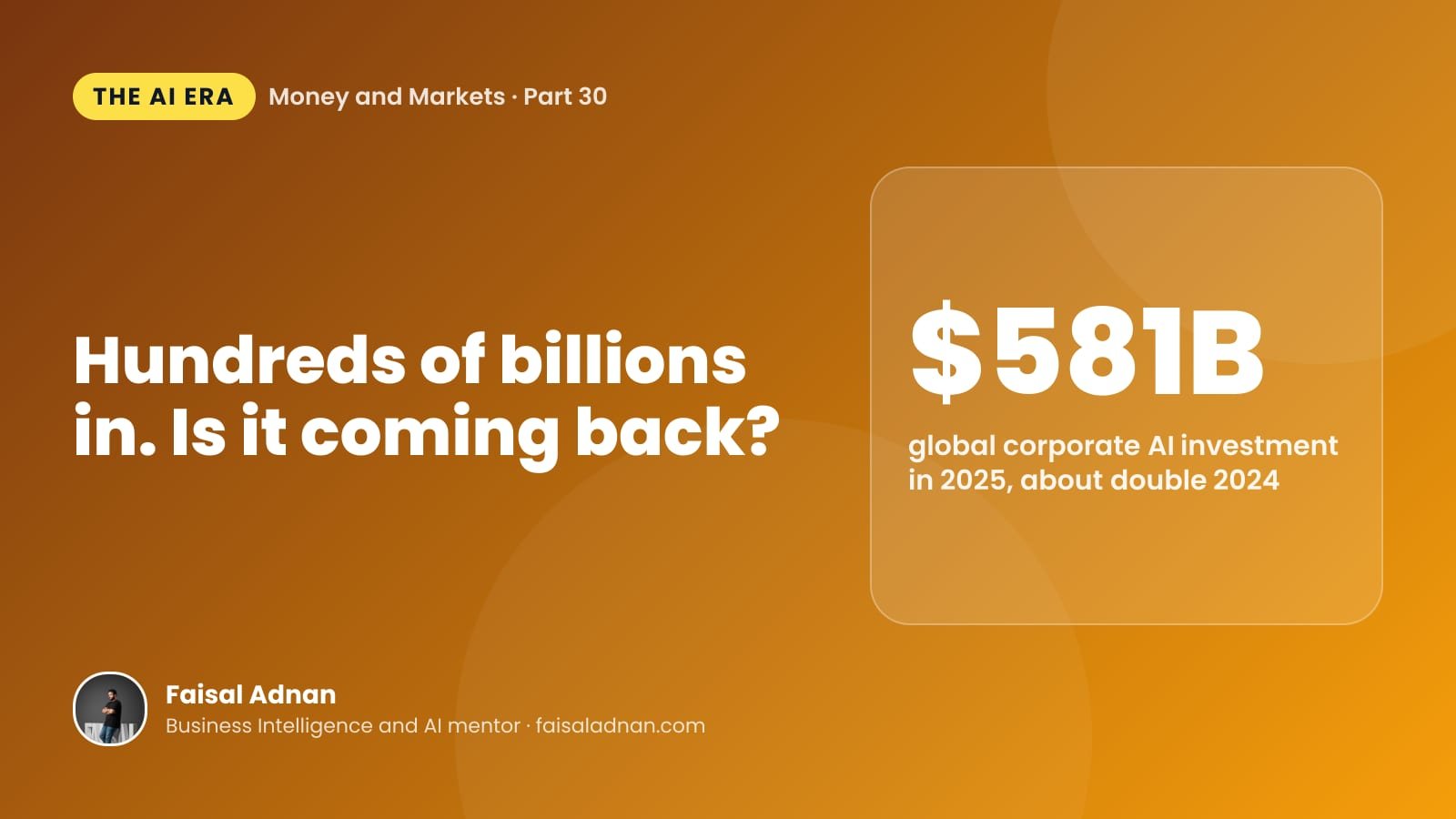
Behind every chatbot reply is a data centre, and behind every data centre is a very large cheque. The amount of money flowing into AI is so big that it can be hard to picture. This post collects the main numbers, explains who is paying, and asks the question every investor and every employee is asking: will it pay off? Please note that nothing here is investment advice.
Key takeaways
- Global corporate AI investment reached about $581 billion in 2025, roughly double 2024. Big Tech capex is forecast at $803 to $828 billion for 2026.
- Some demand is financing rather than customers: Nvidia investing up to $100 billion in OpenAI, which then buys Nvidia chips.
- MIT's NANDA report found 95% of enterprise generative AI pilots showed no measurable profit impact, blaming integration more than weak models.
How much is being invested
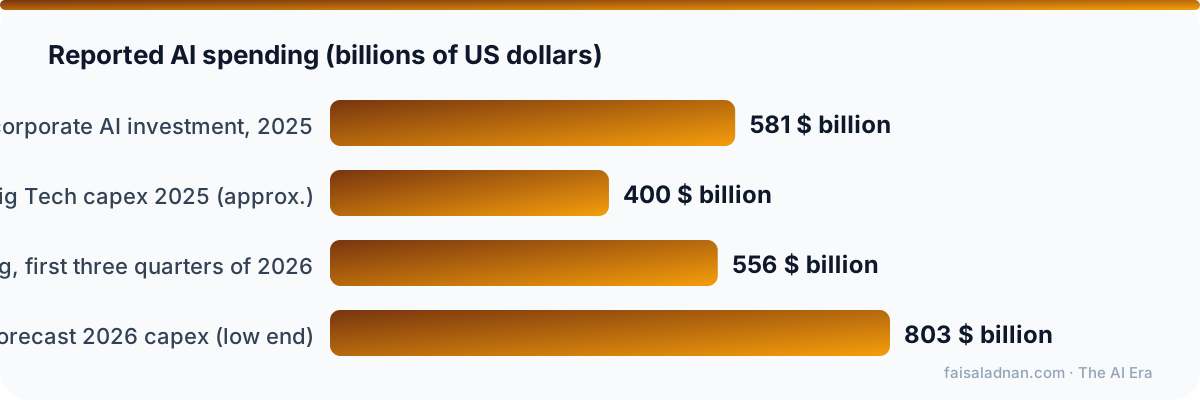
- $581 billion of global corporate AI investment in 2025, about double 2024, according to a breakdown of the Stanford AI Index 2026.
- Big Tech capex: Sherwood reported that Amazon, Alphabet, Microsoft and Meta spent nearly $400 billion on capital expenditure in 2025, mostly to build AI infrastructure, and were expected to spend roughly 50% more in 2026.
- Hargreaves Lansdown, citing Business Insider, said five hyperscalers had spent about $556 billion over the first three quarters of 2026 and that full-year spending was forecast at $803 to $828 billion. Amazon's own 2026 guidance alone is around $220 billion.
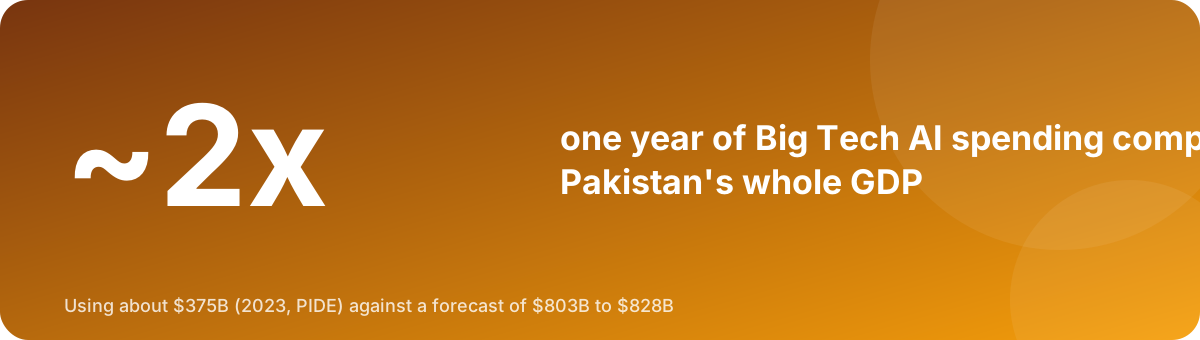
For a sense of scale, compare it with Pakistan's economy. One year of this spending is roughly twice Pakistan's entire GDP, which was around $375 billion in 2023, per PIDE.
Valuations
Bloomberg Law reported that Anthropic raised $65 billion at a $965 billion valuation, eclipsing OpenAI's for the first time, and the company filed for an IPO in October. OpenAI closed a $122 billion round at an $852 billion valuation, also reported by Bloomberg Law.
Circular deals
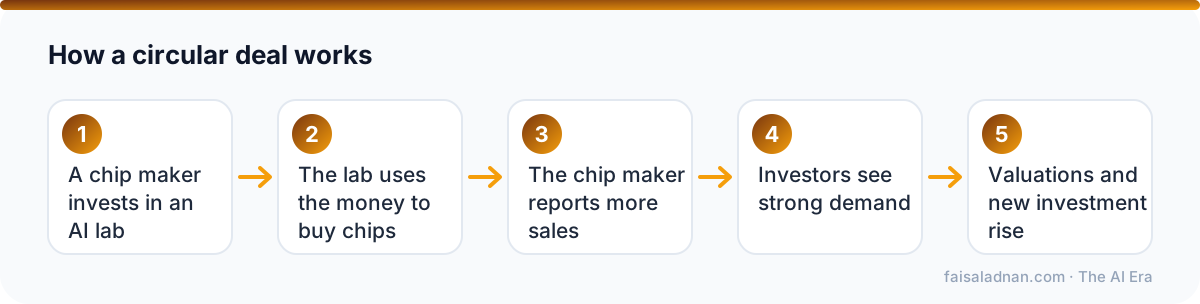
Part of the demand is funded by the same companies that sell the supplies. Nvidia announced it would invest up to $100 billion in OpenAI, which then buys Nvidia chips. AMD gave OpenAI warrants. Oracle signed a $300 billion compute deal. None of this is illegal, but it means that some of the apparent demand is financing, not customers.
Where is the profit?
MIT's NANDA initiative published "The GenAI Divide" in August 2025. As Fortune summarised it, 95% of enterprise generative AI pilots showed no measurable profit impact, and the report blamed poor integration rather than weak models. Companies that bought tools from vendors did better than those that tried to build everything in house.
This week: a correction
On 2 November 2026 Bloomberg reported that the Nasdaq-100 tumbled into a correction, down 10.4% from its October record, as investors doubted that AI spending would pay back. The chip index was down 29% from its June peak.
What I want you to think about
- Market prices will rise and fall, and I cannot predict them. Please do not use anything here as investment advice.
- The skills are a separate question from the stock prices. Even in a correction, companies still need people who can make these tools useful.
- Follow the unit economics, not the headlines. The key question for any AI product is whether the money it earns exceeds the cost of running it.
Is it a bubble? The honest answer is that smart people disagree. Read both arguments in Is AI a Bubble? Both Sides Have a Point.
Keep reading
- Is AI a Bubble? Both Sides Have a Point
- You Are Not Early and You Are Not Late: The Numbers Behind the AI Boom
- Two Years, Every Month a Headline: AI From Sora to GPT-5 and Nano Banana
See the complete AI Era series

Written by Faisal Adnan
Business Intelligence and AI mentor. I teach Data Analytics, Power BI, Microsoft Fabric, SQL, Python and applied AI, and write about what is changing and what it means for your career.