Hollywood's Love-Hate Year: Veo, the End of Sora, Kling and the Lawsuits
Faisal Adnan · 05 Nov 2026
Few industries feel the pull of AI as strongly as film and video. The technology can produce footage that once needed a crew, a camera and a budget, and the people who make a living from those things are worried and curious at the same time. This post follows the last year of that story.
Key takeaways
- Google reported more than 275 million videos generated in its Flow film tool by October 2025.
- OpenAI announced it was shutting down the Sora app, and hype turned out not to be a business model because video generation is expensive to run.
- Copyright is the battlefield of creative AI. Disney, Universal and Warner Bros. units have sued Midjourney.
Google Veo 3 and Flow
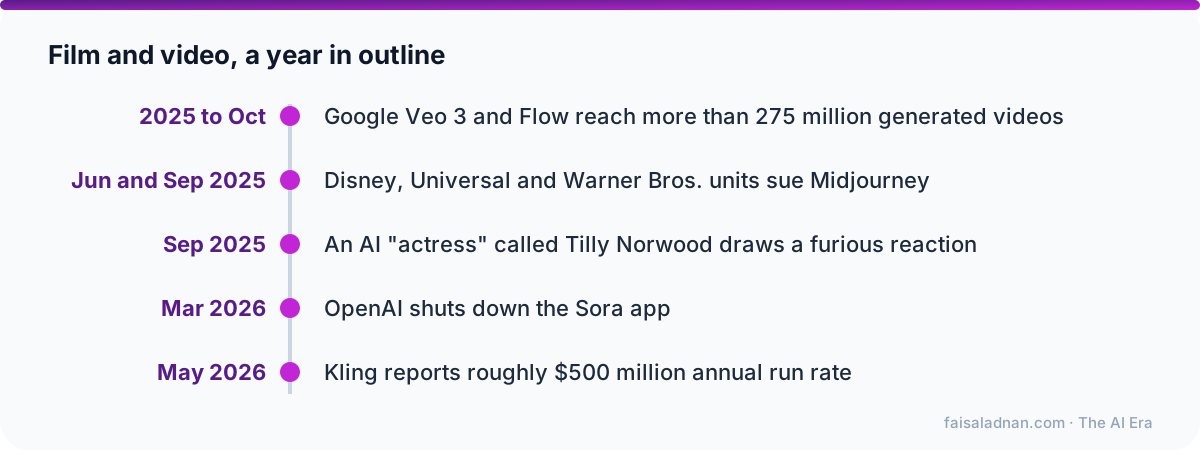
Google's Veo 3 generates video with dialogue, sound effects and camera control. According to Google, more than 275 million videos had been generated in its Flow film tool by October 2025. Veo 3.1 added new audio controls, and Google DeepMind keeps sample clips on the Veo page. The jump from silent clips to scenes with speech and sound made the output far more usable for storytelling.
Sora: rise and fall
The Sora app was downloaded a million times in five days, as reported at the time. Then, as Engadget reported, OpenAI announced it was shutting down the app in a pivot away from consumer AI. In its own post the company said "We're saying goodbye to Sora". I note the shutdown in March 2026, reportedly because of compute costs, and a planned $1 billion Disney deal that unravelled.
The lesson is blunt: hype is not a business model. Video generation is expensive to run, because every second of footage needs a huge amount of computing power.
Kling: the race is global
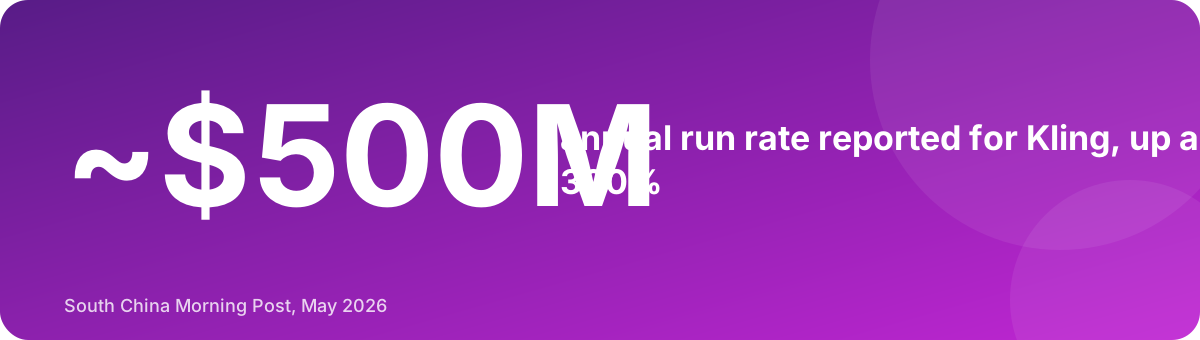
The South China Morning Post reported in May 2026 that Kuaishou, the Chinese company behind the Kling video generator, beat estimates, with Kling's revenue up about 300% and an annual run rate of roughly $500 million.
Anyone who thinks this is only an American contest has not looked at the numbers.
Tilly Norwood, the AI actress
In September 2025 a studio introduced an AI-generated "actress" named Tilly Norwood. TechCrunch reported that Hollywood did not take it kindly. The actors' union SAG-AFTRA said she is "not an actor", and the actress Emily Blunt reacted with "Good Lord, we're screwed." The reaction shows what is really at stake: not only jobs, but the idea that a performance should come from a human being who can be hired, credited and paid.
The lawsuits
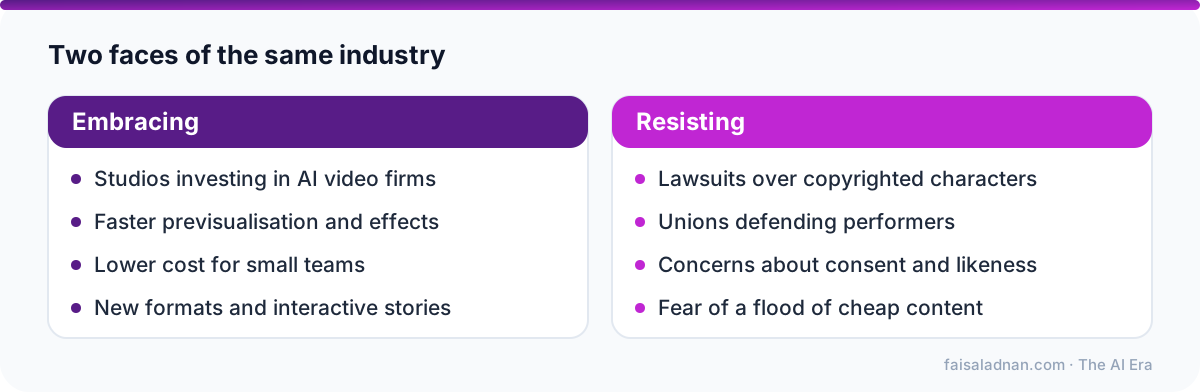
Disney and Universal sued Midjourney in June 2025, and on 4 September Warner Bros. Discovery units filed a very similar complaint. They argue that Midjourney let subscribers generate their copyrighted characters. Disney's complaint called Midjourney "a bottomless pit of plagiarism". Copyright is the battlefield of creative AI, and the courts have a lot left to decide.
And the partnerships
Lionsgate took an equity stake in the AI video company Runway to co-develop a series. The industry is both fighting and embracing the technology at the same time, depending on who owns the rights and who controls the tools.
If you want to work in media
- Learn the tools, but also learn rights, licensing and consent. They decide who can use what.
- Develop taste. Storytelling, taste and direction are the skills that survive a world with cheap pixels.
- Keep a portfolio of work you can explain, including what you made, what the AI made and what choices you made between them.
The big question for the next few years is not whether AI can make a good-looking clip. It is who gets paid when it does. Read how the same shift is reaching game development.
Keep reading
- Two Years, Every Month a Headline: AI From Sora to GPT-5 and Nano Banana
- Type a World, Walk Into It: Genie 3 and What AI Means for Game Development
- Is That Real? Increasingly, No: AI Slop, Fake Articles and Election Deepfakes
See the complete AI Era series
Written by Faisal Adnan
Business Intelligence and AI mentor. I teach Data Analytics, Power BI, Microsoft Fabric, SQL, Python and applied AI, and write about what is changing and what it means for your career.