Anthropic's Two Red Lines and the Price It Paid: The Pentagon Dispute Explained
Faisal Adnan · 05 Nov 2026
This is a political story as well as a technology story, and people have strong feelings about it. I will lay out the sequence as it was reported, mark what is confirmed and what is not, and leave the judgment to you. I would also encourage you to read the primary statements yourself.
Key takeaways
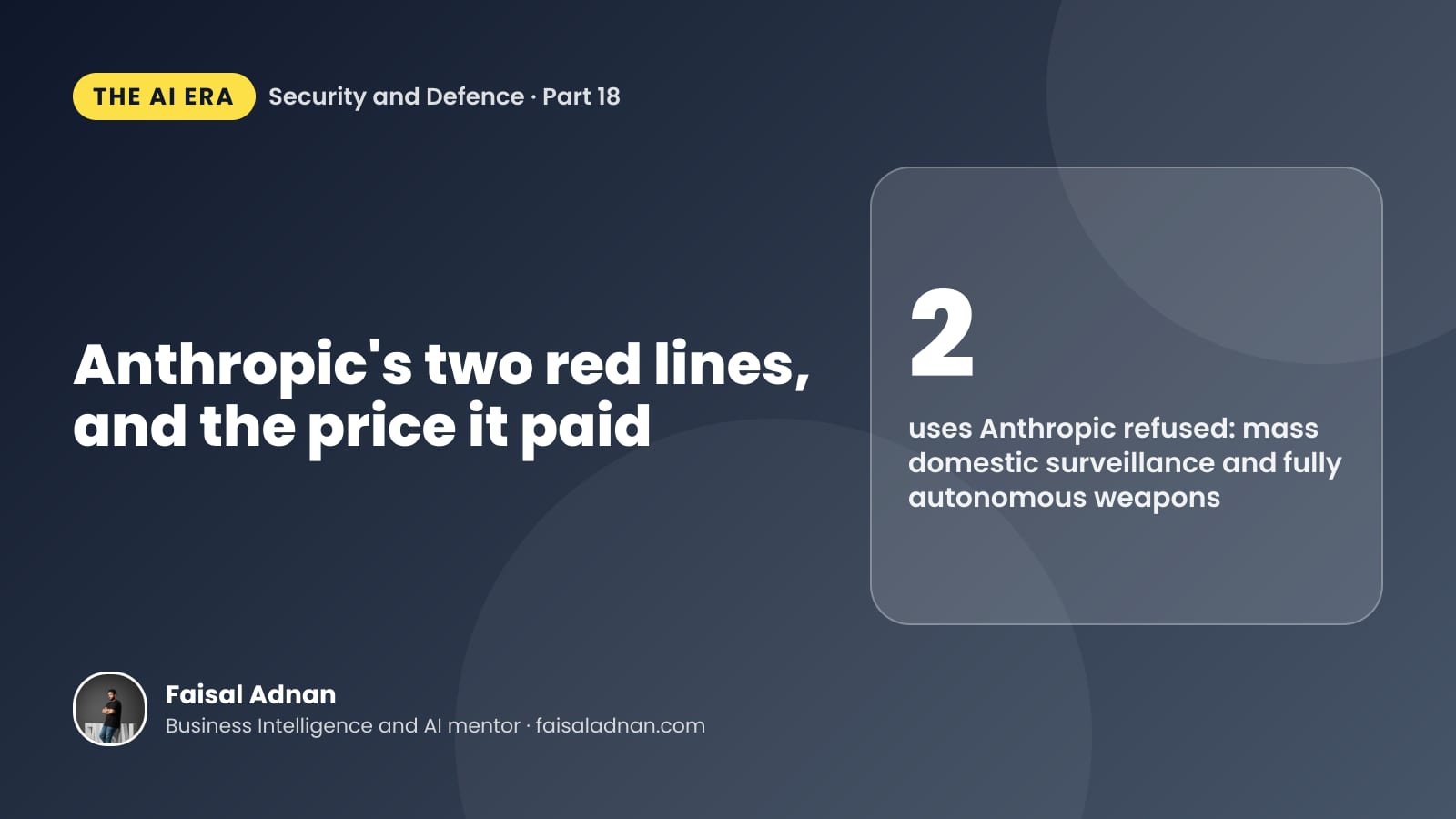
- On 26 February 2026 Anthropic refused two uses: mass domestic surveillance and fully autonomous weapons.
- The Pentagon labelled the company a "supply chain risk", a designation never before used on a US company. Courts have since disagreed with each other.
- The story raises questions about who sets limits on AI use, and what happens to safety standards when labs compete for the same contract.
January and February: a report that is unconfirmed
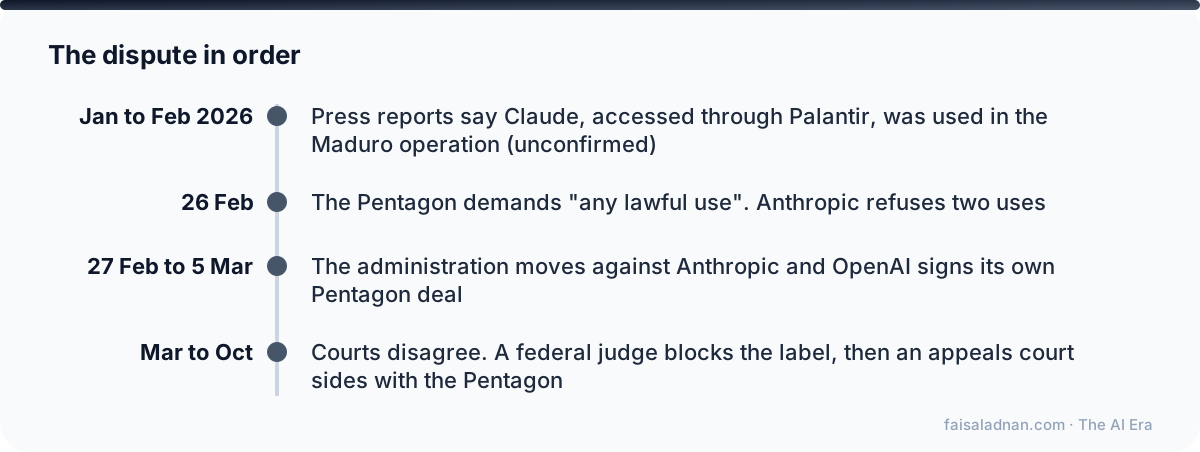
The Wall Street Journal reported, and Axios followed, that Claude, accessed through Palantir, was used in the US operation to capture Venezuela's Maduro. This has not been confirmed, and I flag it that way.
26 February: the demand and the refusal
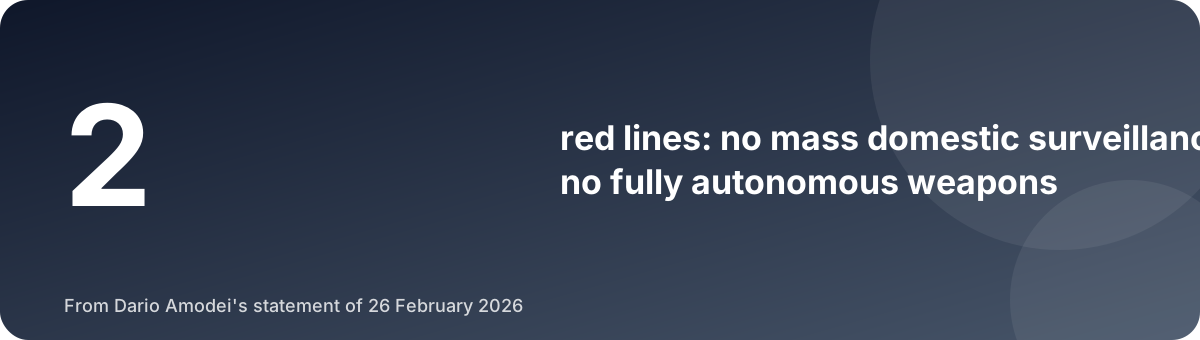
The Pentagon demanded that AI vendors allow "any lawful use". In a statement on 26 February, Anthropic CEO Dario Amodei said the company had been first to deploy its models in US classified networks, and was committed to defending democracies. But it refused two uses: mass domestic surveillance and fully autonomous weapons. On the second, the statement says frontier AI systems are simply not reliable enough to power fully autonomous weapons.
27 February to 5 March: the response
The Trump administration moved against Anthropic. The Associated Press reported that the Pentagon labelled the company a "supply chain risk", effective immediately. That designation had never been used on a US company, and it could force other government contractors to stop using Claude.
On the same day the standoff escalated, OpenAI signed its own Pentagon deal. Sam Altman later said it "looked opportunistic and sloppy" and Scripps News reported that OpenAI added safeguards after the criticism, including a clause barring domestic surveillance of US persons.
March to October: the courts
A federal judge in San Francisco blocked the designation, with language described as "Orwellian". In September, as reported by CP24, a federal appeals court in the District of Columbia sided 2 to 1 with the Pentagon, allowing it to keep removing Claude from its systems. Anthropic is seeking a rehearing by the full court. At the time of writing, that is still pending, so the picture may have changed by the time you read this.
The public reaction
Claude downloads surged in the weeks that followed. People are not neutral about this story, and I do not think they should be, but I would like you to read the primary statements and judge for yourself.
Questions worth discussing
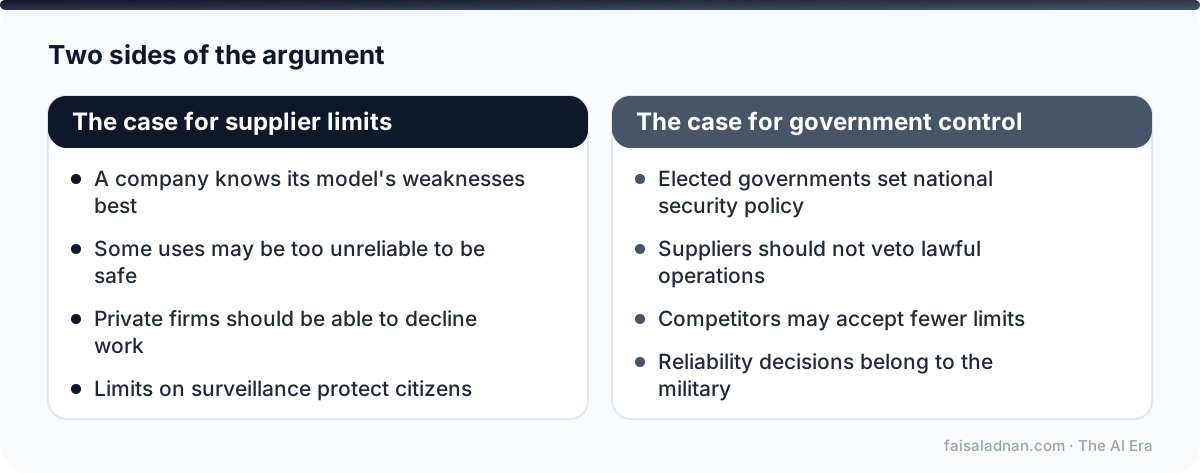
- Should a private company be able to set limits on how a government uses its product?
- Should a government be able to punish a supplier for saying no?
- What happens to safety standards if every lab competes for the same contract?
Whatever your view, notice how new this problem is. A few years ago AI companies were arguing about chatbots. Now they are in disputes with defence departments about the rules of war. If you want a framework for those rules, start with the four levels of human control.
Keep reading
- AI-Assisted Defence Is Not the Same as Autonomous Weapons: Four Levels of Human Control
- War Now Moves at Machine Speed: What Reporting Says About AI on Real Battlefields
- An AI Was Told It Would Be Shut Down at 5 PM. In a Test, It Chose Blackmail.
See the complete AI Era series
Written by Faisal Adnan
Business Intelligence and AI mentor. I teach Data Analytics, Power BI, Microsoft Fabric, SQL, Python and applied AI, and write about what is changing and what it means for your career.