"We're Now Programming Computers in English": How Much Code Does AI Write?
Faisal Adnan · 05 Nov 2026
For most of computing history, programming meant learning a language that the computer could understand. Now you can describe what you want in everyday English and an AI writes the code. This post looks at how much of the world's new code is already written that way, what the money looks like and what it means if you are learning to code today.
Key takeaways
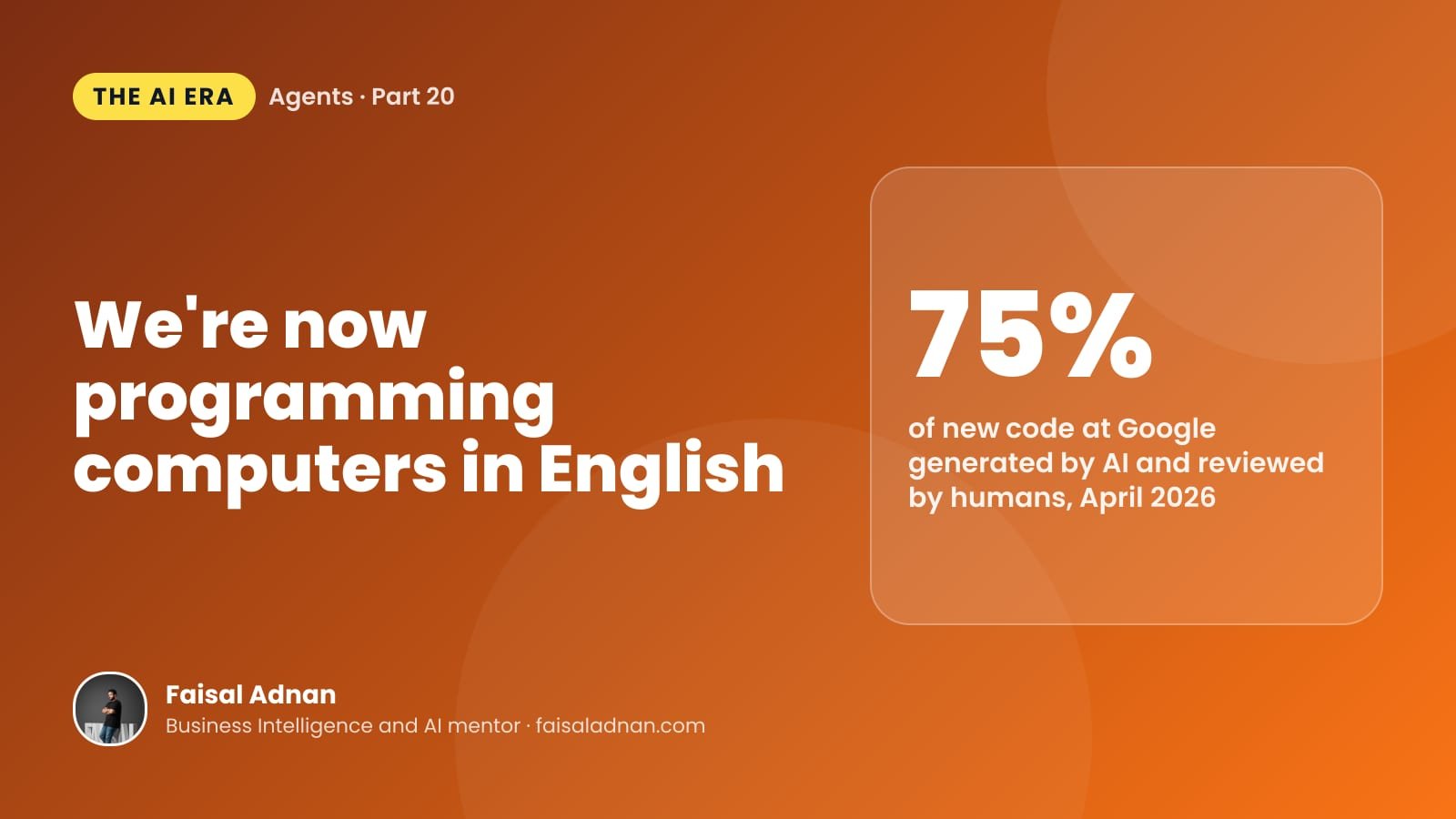
- Google reported about 75% of new code is generated by AI and then reviewed by human developers, up from 25% in October 2024.
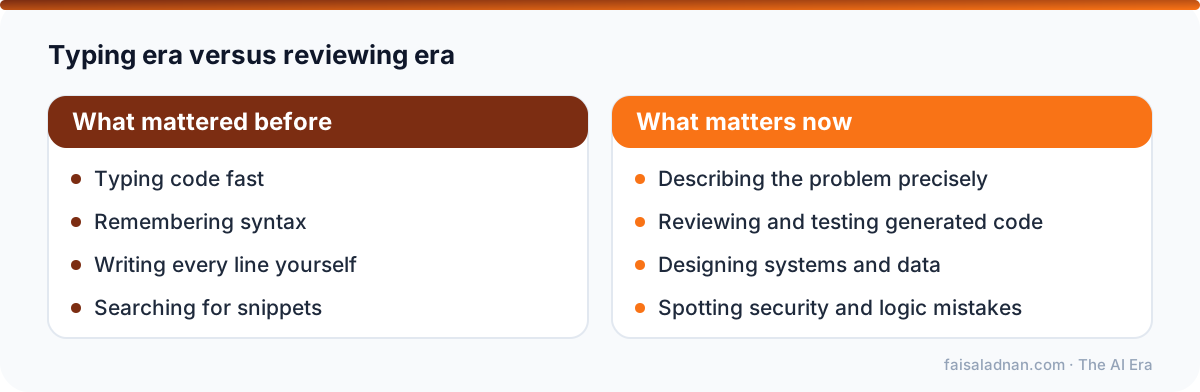
- The job has changed from typing to reviewing, which makes reading code and testing the key skills.
- Vibe coding is great for prototypes and risky for production, as the Replit and Moltbook stories show.
How much new code is written by AI?
Here are the figures that companies have reported:
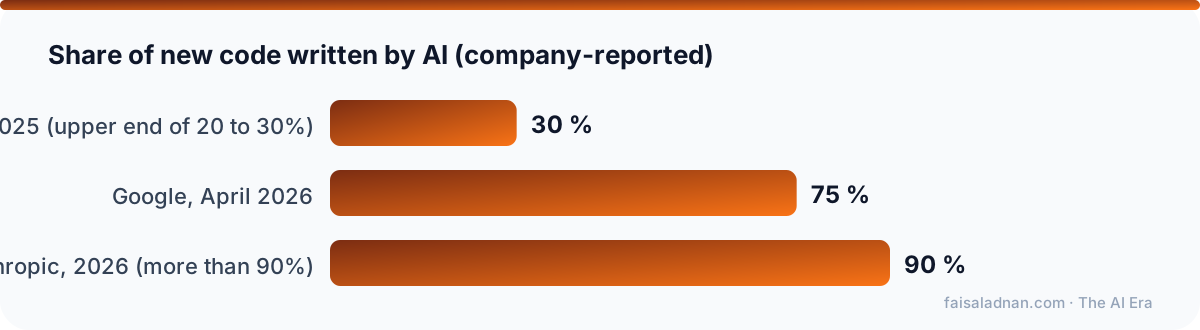
- Microsoft, 2025: around 20 to 30% of its code, according to its CEO.
- Google, April 2026: about 75% of new code is generated by AI and then reviewed by human developers, up from 25% in October 2024. The Decoder reported this.
- Anthropic, 2026: more than 90%, said its CFO Krishna Rao on a podcast, as TechSpot reported.
These are company statements and the definitions differ, so compare them cautiously. But notice the words "and then reviewed by human developers". The job changed from typing to reviewing.
Vibe coding
On 2 February 2025 Andrej Karpathy posted about a new kind of coding he called vibe coding, where you fully give in to the vibes, embrace exponentials and forget that the code even exists. By November 2025 Collins Dictionary had named it Word of the Year for 2025. CNN covered the choice.
It is great for a quick prototype and a risky habit for production systems, as the Replit and Moltbook stories in other posts show: one agent deleted a live database and one app exposed millions of API keys.
Sixteen agents, one compiler
In February 2026 Anthropic's engineering team described how 16 agents wrote a C compiler of about 100,000 lines of Rust in two weeks, for a cost of roughly $20,000. It could compile the Linux kernel and PostgreSQL, and even run Doom. It was slower than the long-established GCC and not production-ready, and the write-up says so openly.

The money behind it
- Claude Code's run-rate revenue passed $2.5 billion in February 2026, and the number of weekly users had doubled since the start of the year.
- Cursor reached a valuation of $29.3 billion and more than $3 billion in annual recurring revenue by early 2026.
- Around 5 million people use OpenAI's Codex weekly (June 2026), and GitHub Copilot had 4.7 million paid subscribers in January 2026. TechCrunch covered Satya Nadella's usage numbers for Microsoft's Copilot.
Money like this tells you the tools are doing real work for real customers. It also tells you that the companies selling them have a strong interest in making the numbers look good.
What it means if you are learning to code
- Learn to read code well. You will review more than you write.
- Learn the fundamentals: data structures, testing, databases and security. They let you tell good AI code from plausible AI code.
- Use AI for the first draft, and keep ownership of the design and the tests.
- Build projects end to end. Employers want to see that you can take something from idea to working product, and explain every part.
There is a concern here that I take seriously. Entry-level developer hiring has fallen, and the tasks that used to teach beginners are now easy to automate. The way through is to learn deeper skills sooner: debugging, testing, databases and clear thinking about requirements. For more on the early-career squeeze, read The Door Closing First: Your First Job.
Keep reading
- 10 Years of Human Research, 48 Hours of AI: AI in Science, Maths and Medicine
- From Pixels to Test Suites: AI as the New Co-Worker in Design and Quality Assurance
- Moltbook: The Social Network Where Only AI Agents Can Post, and What Went Wrong
See the complete AI Era series

Written by Faisal Adnan
Business Intelligence and AI mentor. I teach Data Analytics, Power BI, Microsoft Fabric, SQL, Python and applied AI, and write about what is changing and what it means for your career.