Is That Real? Increasingly, No: AI Slop, Fake Articles and Election Deepfakes
Faisal Adnan · 05 Nov 2026
Open a social media app and scroll for five minutes. How much of what you see was made by a person? A few years ago that question would have seemed strange. Now it is a practical skill. This post gathers the evidence on how much AI-generated content is already in our feeds and gives you a short routine for checking what you see.
Key takeaways
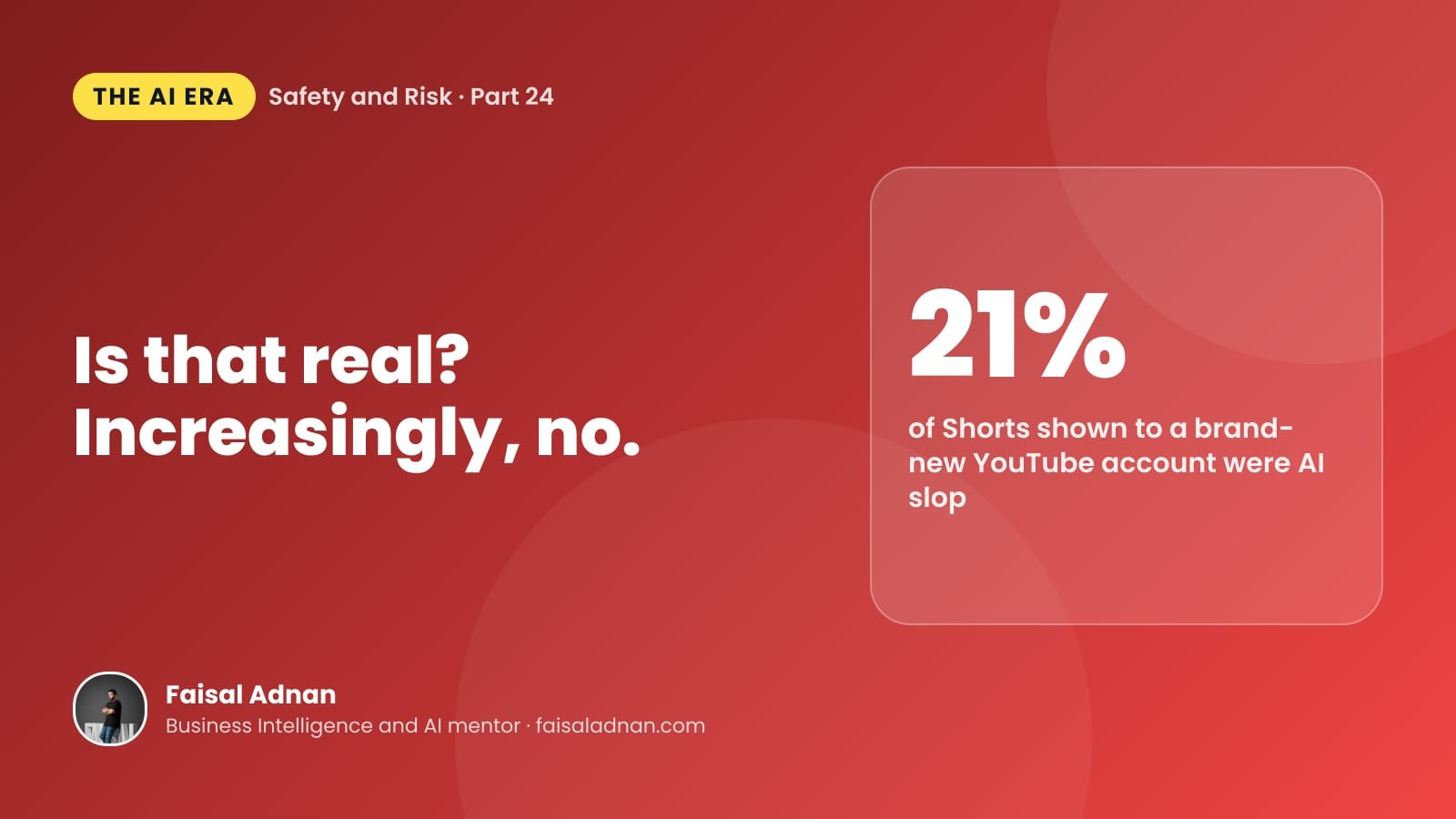
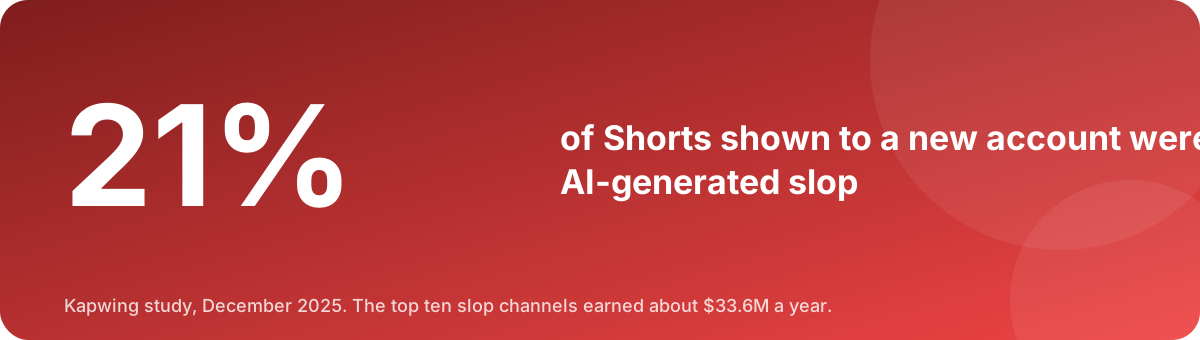
- Kapwing found about 21% of YouTube Shorts shown to a new account were AI-generated slop, and the top ten slop channels earned an estimated $33.6 million a year.
- Graphite found that since November 2024 AI-written articles are about as common online as human-written ones.
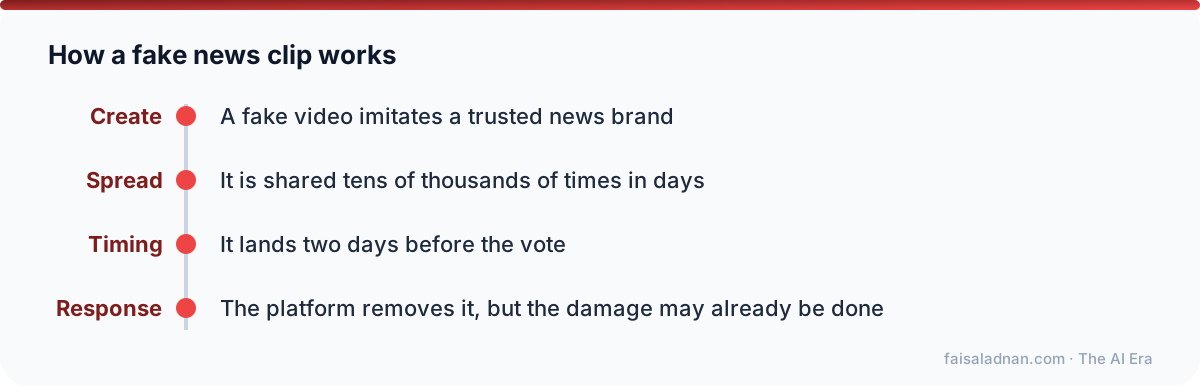
- A fake "RTÉ News" video of an Irish presidential frontrunner was shared roughly 30,000 times two days before the vote.
AI slop in your feed
The video-editing company Kapwing studied what a brand-new YouTube account sees. Its December 2025 study, reported by The Decoder, found that about 21% of the Shorts shown to a new account were AI-generated "slop", and that the top ten slop channels earned an estimated $33.6 million a year. It means low-quality AI video is already a business.
On the web
The analytics firm Graphite looked at 65,000 web articles and found that, since November 2024, AI-written articles are about as common online as human-written ones. Axios covered it. I could not open the Axios page while preparing this post, so check the original study if you plan to cite the number.
An election deepfake
In Ireland's 2025 presidential campaign, a fake "RTÉ News" video showed the frontrunner, Catherine Connolly, announcing that she was withdrawing from the race. It was shared roughly 30,000 times, two days before the vote. Engadget reported that Meta removed it.
Feeds made only of AI
Meta launched Vibes, a feed that shows only AI-generated videos, inside its Meta AI app. Users called it "infinite slop", as Notebookcheck reported.
Your attention is the product
Feeds are optimised to hold you, not to inform you. When content is cheap to produce, the supply is endless, so it matters even more to decide what you let in. It also means that creators who care about accuracy are competing with accounts that publish hundreds of clips a day at almost no cost.
A five-step check before you share
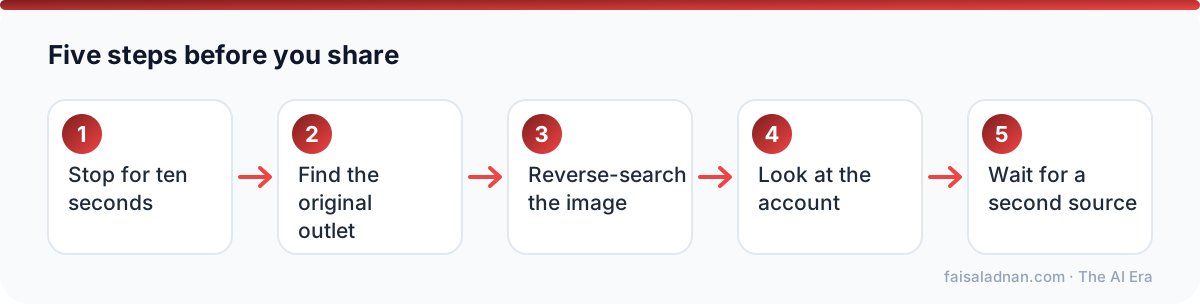
- Stop for ten seconds. Strong emotion is a warning sign. Content designed to make you angry or afraid is built to be shared.
- Find the original outlet. Open the real site of the news organisation instead of trusting a screenshot.
- Reverse-search the image with Google Lens or TinEye. Old photos are often reused with new captions.
- Look at the account. New, anonymous or posting every few minutes should raise suspicion.
- Wait for a second source. If it is true, others will report it.
Tools are not enough
Detection tools exist, but they are not perfect, and a confident "this is real" from a detector can be as misleading as a fake. Treat them as one clue among several. The habits above work whether the fake was made by a person or a machine.
For families, a good rule is to agree that nobody forwards a shocking clip before checking it. For businesses, label what is AI-made and keep a record of where your own content came from. Trust is going to be a competitive advantage. Read how the same problem hits money and security in The Attacker Did Not Hack the AI Did the Hacking.
Keep reading
- Then Machines Started to Create: GPT-3, ChatGPT, GPT-4 and the Pope in a Puffer Jacket
- The Attacker Did Not Hack the AI Did the Hacking: AI-Run Espionage and the $25 Million Deepfake Call
- When Guardrails Slip, It Happens at Scale: What the Grok Incidents Teach Us
See the complete AI Era series

Written by Faisal Adnan
Business Intelligence and AI mentor. I teach Data Analytics, Power BI, Microsoft Fabric, SQL, Python and applied AI, and write about what is changing and what it means for your career.