10 Years of Human Research, 48 Hours of AI: AI in Science, Maths and Medicine
Faisal Adnan · 05 Nov 2026
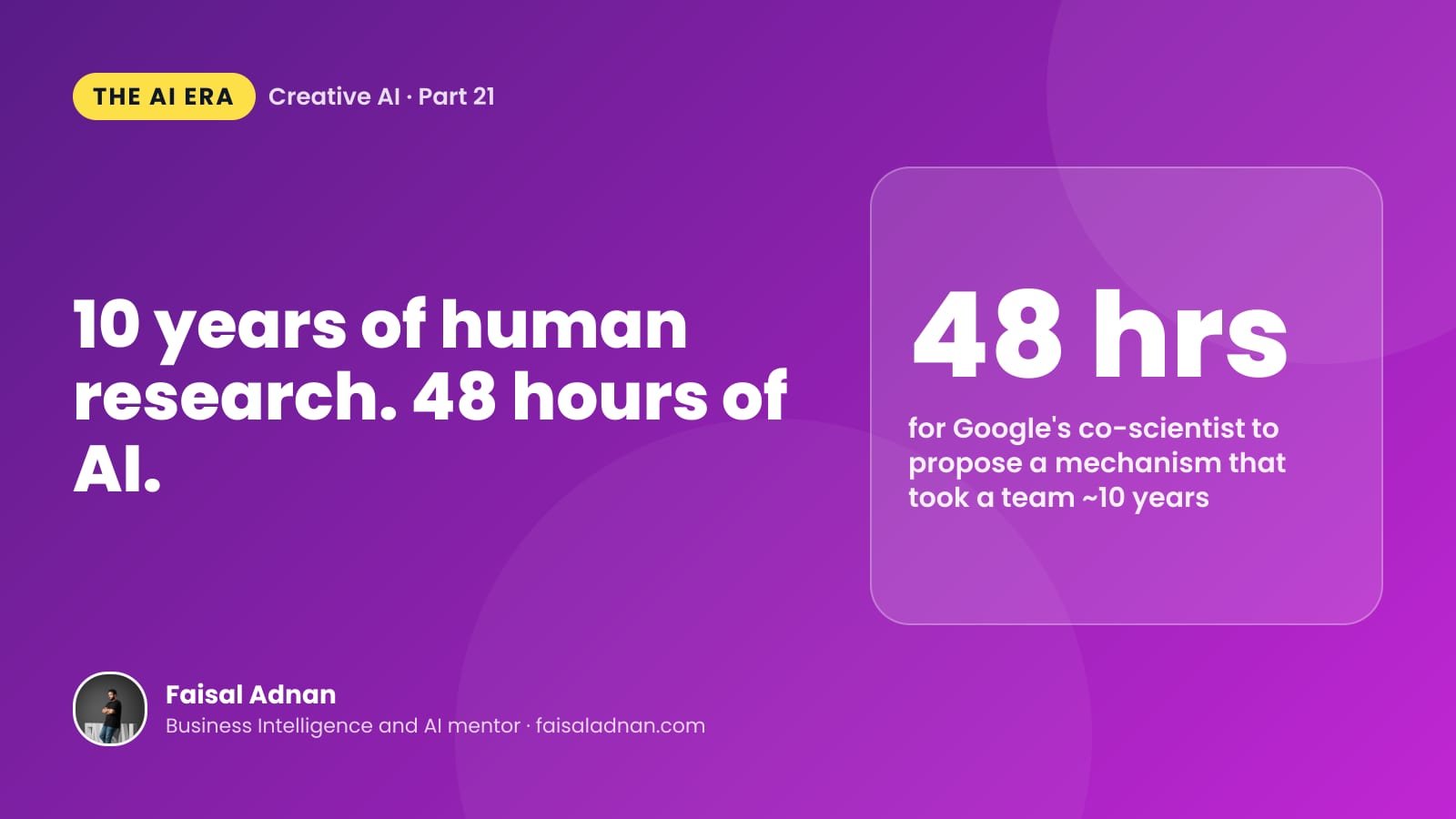
When people talk about AI, they often picture chatbots and image generators. But some of the most important changes are happening in laboratories, maths departments and drug companies. This post collects the best-known examples from the past two years and adds the caveats that the headlines usually leave out.
Key takeaways
- Google's co-scientist proposed in about 48 hours the same unpublished mechanism an Imperial College team had worked on for around ten years, but it worked from published literature and the idea still needed lab confirmation.
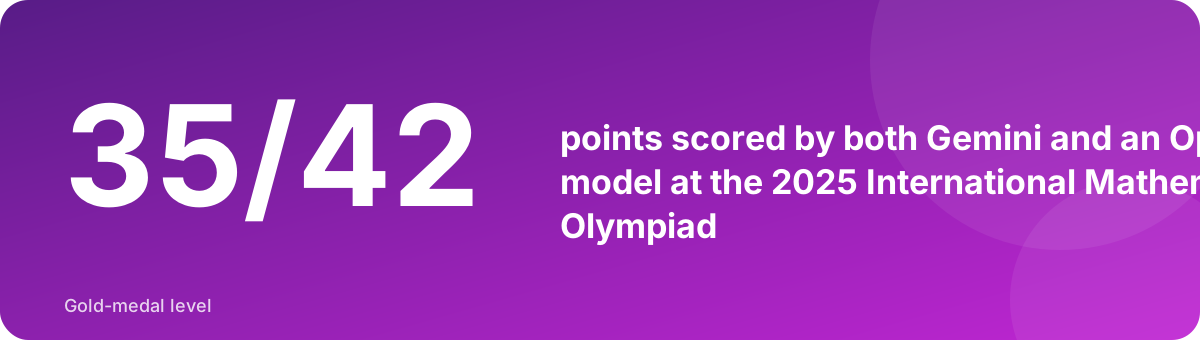
- In 2025 both Gemini and an OpenAI model reached gold-medal level at the International Mathematical Olympiad, scoring 35 out of 42.
- Fast hypotheses only matter if experiments can test them. The lab is still the bottleneck.
The superbug mystery
Google introduced "co-scientist", an AI designed to act as a colleague for researchers with its own ideas and analysis. According to the reports, a team at Imperial College London had spent around ten years on a problem in antimicrobial resistance. The AI proposed the same, then unpublished, mechanism in about 48 hours.
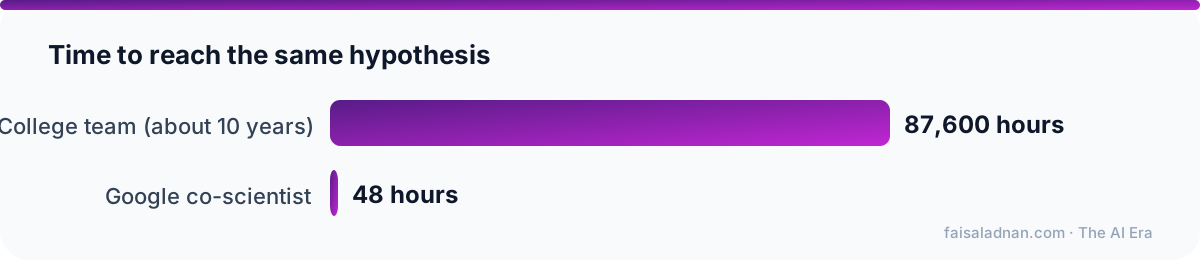
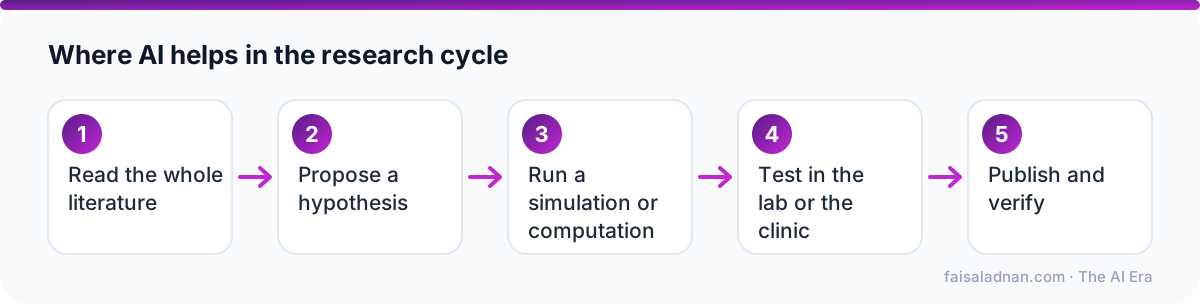
The caveat is important. The AI worked from the field's published literature, and the hypothesis still needed lab confirmation, which the team had already done. The AI did not replace the experiment. It showed that a good idea may sit hidden in what people have already published.
Mathematics: from olympiads to open problems
- At the 2025 International Mathematical Olympiad, both Google's Gemini and an OpenAI model reached gold-medal level with 35 out of 42 points.
- In January 2026, GPT-5.2 helped solve five open problems posed by Paul Erdős. The Rényi Institute in Hungary published an interview with researcher Dániel Varga about this, noting that ChatGPT had solved several of the more than 1,000 unsolved Erdős problems.
- In May 2026, an AI disproved an 80-year-old Erdős conjecture, which I cover in another post.
AlphaEvolve: AI that improves algorithms
Google DeepMind's AlphaEvolve pairs Gemini models with an evolutionary process. VentureBeat reported that it beat Strassen's 1969 record for multiplying 4x4 complex matrices, using 48 multiplications, and that the improved algorithms recovered around 0.7% of Google's worldwide computing resources. A fraction of a percent sounds small until you remember how large Google's computing bill is.
Medicine: a drug found with AI
Insilico Medicine's rentosertib is for a lung disease called idiopathic pulmonary fibrosis. According to the company, AI found both the target and the molecule. Its Phase IIa results were published in Nature Medicine on 3 June 2025, described as the first proof-of-concept clinical validation of AI-driven drug discovery. The company's materials note that candidate time can fall to 12 to 18 months from 2.5 to 4 years.
Phase IIa is early evidence of safety and signals of efficacy, not an approved medicine. A drug still needs larger trials before patients can rely on it.
The Nobel and the AI Scientist
AlphaFold earned the 2024 Nobel Prize in Chemistry, with about 200 million protein structures predicted and millions of researchers using them. In March 2026, Sakana's "AI Scientist" system reportedly wrote a full paper that passed peer review at a workshop of the ICLR conference. I could not access the original report while writing, so I treat it as a claim.
My caution
- Fast hypotheses are only valuable if experiments can test them. The lab is still the bottleneck.
- Always ask who verified a result, and whether it was before or after the news cycle.
- Beware survivor stories. We hear about the problems AI solved, not the ones it got wrong.
What it means for you
The opportunity is to be the person who can combine domain knowledge with these tools. A biologist who understands both biology and how to question an AI's output will be more valuable than either a pure programmer or a scientist who ignores the tools. The same applies to finance, engineering, education and public health. Whatever your field, find the part of it that is slow, literature-heavy or repetitive, and ask where an assistant could speed it up without lowering the standard of proof.
Keep reading
- AI in 2026 So Far: Models That Find Bugs, Run Software and Do Research
- "We're Now Programming Computers in English": How Much Code Does AI Write?
- Shrinking Tasks vs Growing Roles: Which Jobs Are Under Pressure and Which Are Growing
See the complete AI Era series

Written by Faisal Adnan
Business Intelligence and AI mentor. I teach Data Analytics, Power BI, Microsoft Fabric, SQL, Python and applied AI, and write about what is changing and what it means for your career.