World-Class AI Education for Rs. 0: A Free Four-Step Learning Roadmap
Faisal Adnan · 05 Nov 2026
The best AI courses in the world are free. What most people lack is not access but order and follow-through. This roadmap gives you both: four steps, a few courses at each, and some rules for actually finishing. The resource names are plain text; each is easy to find by searching its name.
Key takeaways
- Four steps: basics, deep learning, large language models, then build and ship one project.
- Move to the next step only when you have built something with the current one.
- Nobody gets hired for watching courses. They get hired for something they built and can explain.
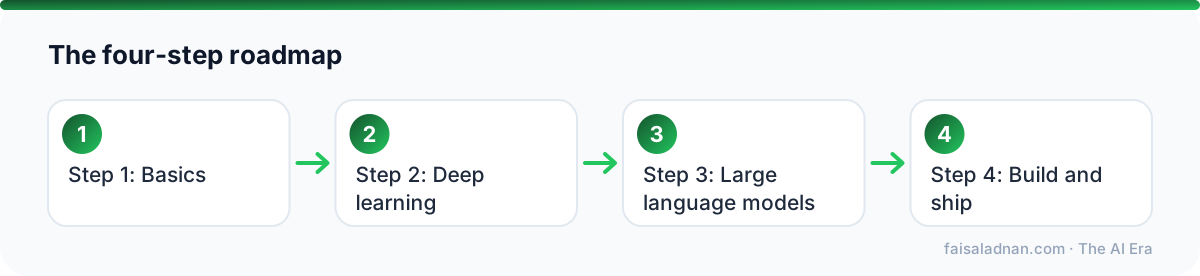
Step 1: basics
- Kaggle Learn (kaggle.com/learn): short, hands-on lessons in Python, pandas and intro machine learning. You write code from the first page.
- Google Machine Learning Crash Course (developers.google.com/machine-learning/crash-course): core concepts such as linear regression, classification and loss, with interactive visuals.
Step 2: deep learning
- fast.ai, Practical Deep Learning for Coders (course.fast.ai): free, top-down, for people with some coding experience who want to apply deep learning to practical problems.
- Neural Networks: Zero to Hero (Andrej Karpathy, on GitHub and YouTube): you code and train neural networks from the basics, and build a GPT from scratch, line by line.
Step 3: large language models
- Hugging Face Learn (huggingface.co/learn): courses on LLMs, agents and NLP, with free notebooks.
- DeepLearning.AI short courses: one-hour courses on retrieval, agents and evaluation. Andrew Ng also teaches an "AI Prompting for Everyone" course there.
- Generative AI for Beginners (Microsoft, on GitHub): 21 lessons with translations in many languages.
Step 4: build and ship
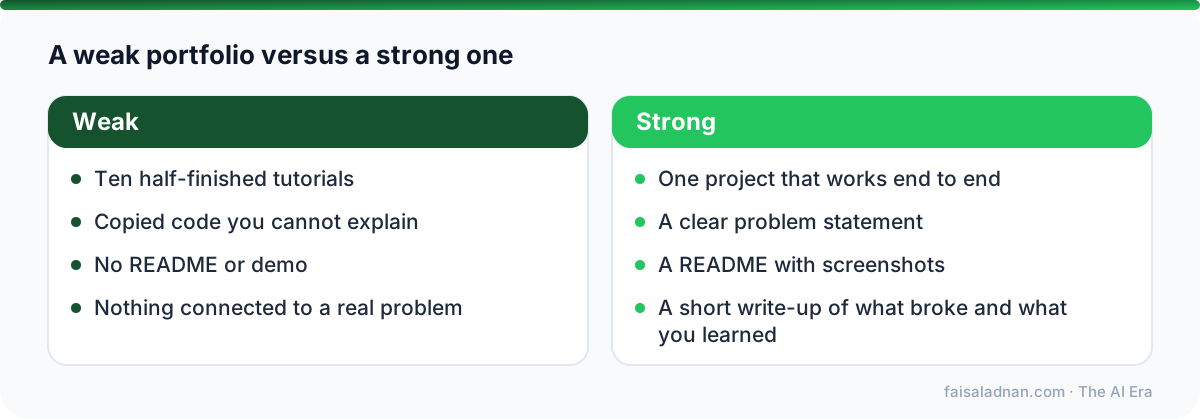
Pick one project, solve a local problem and publish it on GitHub. Not ten projects. One project that you can explain in five minutes and that someone else can run.
How to actually finish
- Set a weekly target of five hours, and put them in your calendar like a class.
- Move to the next step only when you have built something with the current one.
- Write a short note on each course: what you built, what broke, what you learned.
- Find one study partner. Finishing is easier with someone to report to.
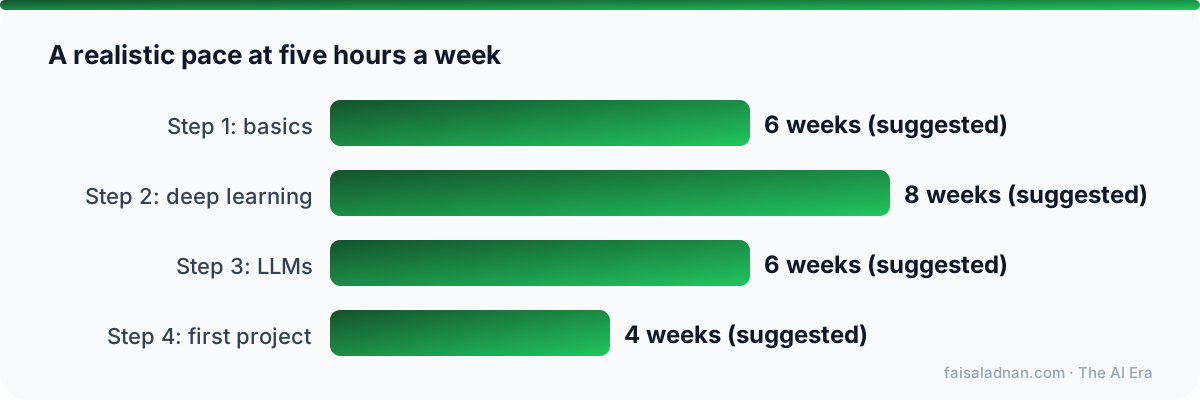
The pace above is only my suggestion; adjust it to your own time. Nobody gets hired for watching courses. They get hired for something they built and can explain. When you are ready to try tools on your own machine, continue with the free toolkit for running AI on your laptop.
Keep reading
- Free AI Toolkit (1/3): Run AI on Your Own Laptop and Build With It
- Free AI Toolkit (2/3): Images, Video, Voice and No-Code Apps With No Paid Subscription
- Pakistan Has an AI Plan. The Question Is Who Fills It.
See the complete AI Era series

Written by Faisal Adnan
Business Intelligence and AI mentor. I teach Data Analytics, Power BI, Microsoft Fabric, SQL, Python and applied AI, and write about what is changing and what it means for your career.