For Decades AI Could Do One Thing: A Short History From Turing to the Transformer
Faisal Adnan · 05 Nov 2026
It is easy to think AI appeared with ChatGPT. It did not. Researchers have been working on it for more than seventy years, and for most of that time every system could do exactly one thing. Understanding that long road makes today's change easier to see. This is the short version.
Key takeaways
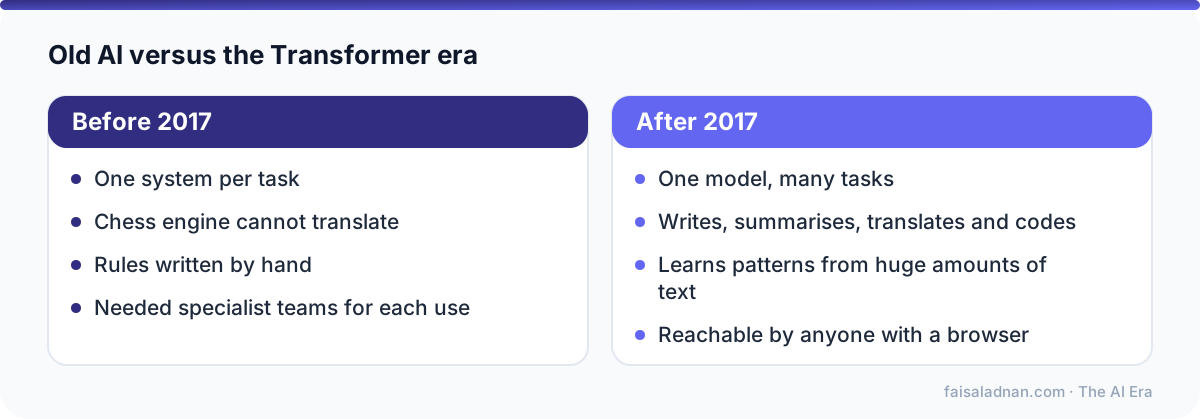
- Old AI was narrow: one task, one machine. Deep Blue played chess and nothing else.
- AlphaGo's Move 37 showed a machine can find an idea no human had tried.
- The 2017 Transformer made AI general purpose: one model, many language jobs, with quality that varies by job.
1950: Turing asks if machines can think
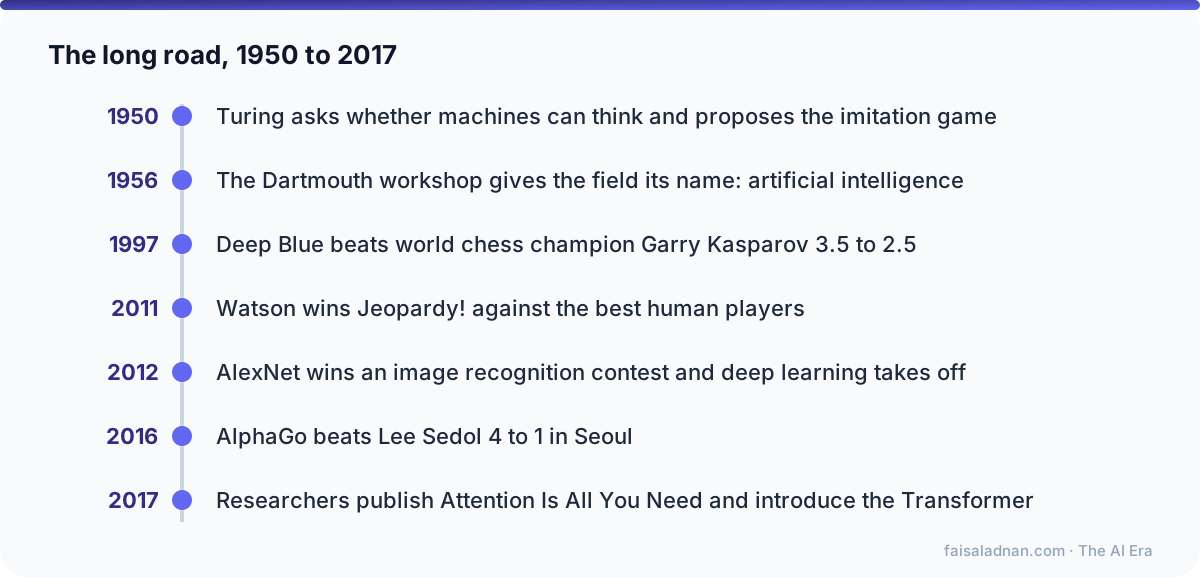
Alan Turing published "Computing Machinery and Intelligence" and opened with a simple question: can machines think? His proposal, known as the Turing Test or the imitation game, was to see whether a person chatting with a machine could tell it apart from a human. Lawrence Livermore National Laboratory, where early AI work was done, has a short history piece on how the research began. Today's chatbots pass versions of that test so routinely that we hardly notice.
1956: the word "AI" is born
The Dartmouth workshop gave the field its name. The organisers believed a summer of work by a small group could crack human-level language. It took roughly 66 years to get something close to that. That is a good reminder to be careful with confident timelines, mine included.
1997: Deep Blue beats Kasparov
IBM's Deep Blue beat world chess champion Garry Kasparov 3.5 to 2.5, searching around 200 million positions per second. It could play chess and nothing else. It was a real achievement, and ChessBase called it a significant step forward for AI. But Deep Blue could not recognise a photo, translate a sentence or answer a question. It was a brilliant tool with one purpose.
2011: Watson wins Jeopardy
Fourteen years later another IBM system, described by ChessBase as about 100 times faster than Deep Blue, beat the best human players at the quiz show Jeopardy. Ken Jennings wrote on his answer screen: "I for one welcome our new computer overlords." Watson was better at language than Deep Blue, but it was still built for one game.
2012: AlexNet teaches machines to see
A deep neural network trained on graphics processors, called AlexNet, won an image recognition contest by a wide margin. That result is why your phone can unlock with your face and find every photo of your dog. It also showed the field that large networks, lots of data and powerful chips could beat hand-written rules.
2016: AlphaGo and Move 37
DeepMind's AlphaGo beat Lee Sedol 4 to 1 in Seoul. The British Go Association's match report records the games in detail. In game two, AlphaGo played a move that professional commentators first thought was a mistake. It was not. It was a creative idea no human had tried. That was the moment many people understood that a machine could do more than copy what humans already knew.
If you have never seen AlphaGo: The Movie, it is a good place to feel what that match was like. It is free to watch.
2017: the Transformer
A team of researchers published "Attention Is All You Need" in June 2017. The architecture it introduced is the "T" in GPT. Almost every large language model you use today descends from it. Its key idea, attention, lets a model look at all the words in a passage at once and decide which ones matter most for understanding each other word.
You do not need the mathematics to appreciate the point. The video above is the clearest visual explanation I know.
The idea to remember
Old AI was narrow: one task, one machine. The Transformer made AI general purpose, so one model can handle many language tasks. That is the shift that matters for your career. You no longer need a different system for translation, summaries and code. One system, many jobs, with a quality that varies from job to job.
That variation in quality is the part to remember. A general-purpose model is not equally good at everything. It can be excellent at drafting an email and unreliable at a specific legal citation. Knowing which is which is a skill, and it is the one this whole series tries to help you build. Next, see how the story continued with the generative big bang of 2020 to 2023.
Keep reading
- Then Machines Started to Create: GPT-3, ChatGPT, GPT-4 and the Pope in a Puffer Jacket
- Two Years, Every Month a Headline: AI From Sora to GPT-5 and Nano Banana
- World-Class AI Education for Rs. 0: A Free Four-Step Learning Roadmap
See the complete AI Era series

Written by Faisal Adnan
Business Intelligence and AI mentor. I teach Data Analytics, Power BI, Microsoft Fabric, SQL, Python and applied AI, and write about what is changing and what it means for your career.