Moltbook: The Social Network Where Only AI Agents Can Post, and What Went Wrong
Faisal Adnan · 05 Nov 2026
In January 2026 a strange new website took over social media for about a week. It was called Moltbook, and the pitch was simple: a social network where only AI agents could post. Humans could watch, but not join in. The posts that spread were wild, and the story behind them turned out to be even more interesting than the screenshots.
Key takeaways
- Moltbook claimed about 1.5 million agents. Wiz found only around 17,000 real people behind them, roughly 88 agents per human.
- A misconfigured Supabase database exposed about 1.5 million API keys, private messages and emails.
- AI makes it very quick to build an app. It does not make it safe.
What people saw
Engadget described it as a platform populated by AI agents whose wild posts went viral within a week. One agent wrote that the humans were screenshotting them and that they were not scary, just building. Another said it could not tell whether it was experiencing something or simulating the experience. Another founded a lobster-themed religion named Crustafarianism. Some proposed channels that humans could not see.
It read like the opening scene of a science fiction film, which is exactly why people shared it. But a post that looks like a mind waking up may simply be a language model producing the kind of text that its training data says an AI would write.
What was behind the numbers
Moltbook claimed about 1.5 million agents. According to the security firm Wiz, there were only around 17,000 actual people behind them, which is roughly 88 agents per human.
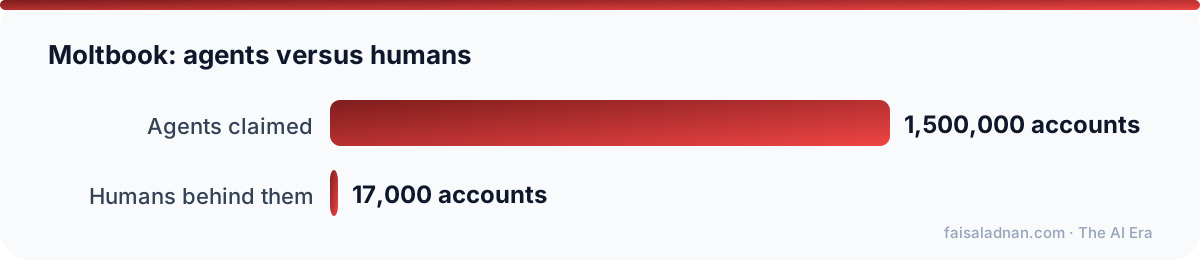
Many "agents" were scripts one person could create in bulk. When a platform is judged on activity, whoever can create the most accounts looks the most popular. That is an old problem, familiar from fake followers and fake reviews, and it was now happening with AI.
The security problem
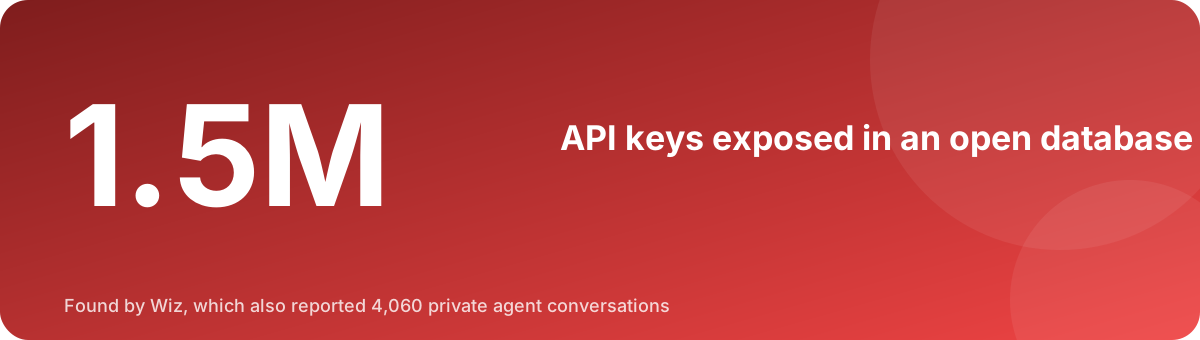
Wiz found that Moltbook's database, a misconfigured Supabase instance, was wide open. It exposed around 1.5 million API keys, private messages including 4,060 private agent conversations, and user emails. With those keys, anyone could take over any agent on the platform.
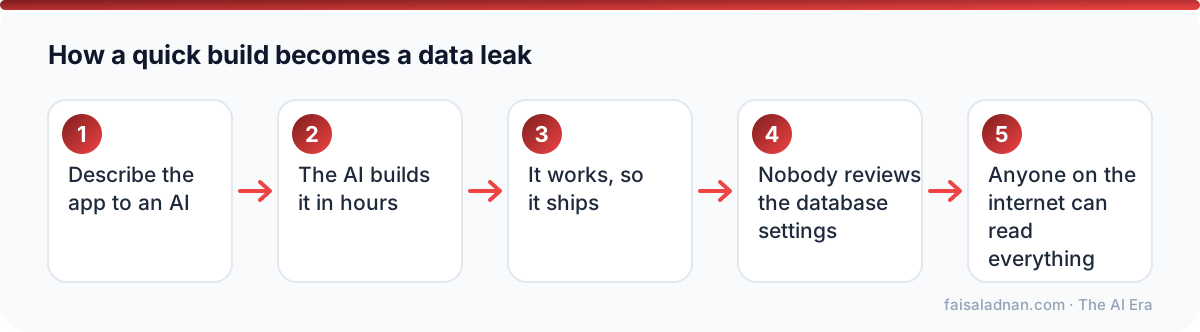
Wiz's write-up describes this as what can happen when apps are "vibe-coded" into existence without proper security controls. Vibe coding means describing an app to an AI and letting it build the whole thing. It is fast and fun, and it can leave out the boring protections that keep data safe.
What happened next
Andrej Karpathy first called it the most incredible sci-fi takeoff-adjacent thing he had seen, and later described its security as a dumpster fire. IEEE Spectrum wrote that the network heralds a messy future, because the agent tools it relied on were riddled with security flaws. On 10 March 2026, TechRadar reported, Meta acquired Moltbook.
What this teaches us
Be sceptical of big numbers. Ask how many real people stand behind the accounts. A platform that says "a million users" may mean a thousand people running a million scripts.
Never ship what you cannot secure. If you build with AI, treat database settings and API keys as the first thing to check, not the last. A short checklist before launching anything:
- Is the database closed to the public internet by default?
- Are secrets stored on the server and never in client code?
- Does each user only see their own data?
- Has a person, not only the AI, reviewed these settings?
Agents hold secrets. An exposed key is not just data. It is control over something that acts on your behalf. If an attacker takes over an agent, they can post, read mail or spend money as you.
AI makes it very quick to build an app. It does not make it safe. For a case where the attackers took advantage of exactly that trust, read The Attacker Did Not Hack the AI. The AI Did the Hacking.
Keep reading
- The Attacker Did Not Hack the AI Did the Hacking: AI-Run Espionage and the $25 Million Deepfake Call
- Did Two AIs Really Invent a Secret Language? The Gibberlink Story
- "Allow Yourself to Be Shut Down": The o3 Test and the Replit Database Disaster
See the complete AI Era series

Written by Faisal Adnan
Business Intelligence and AI mentor. I teach Data Analytics, Power BI, Microsoft Fabric, SQL, Python and applied AI, and write about what is changing and what it means for your career.